Makers · 作家 · Tokoname
Bigei
美芸b. 1939
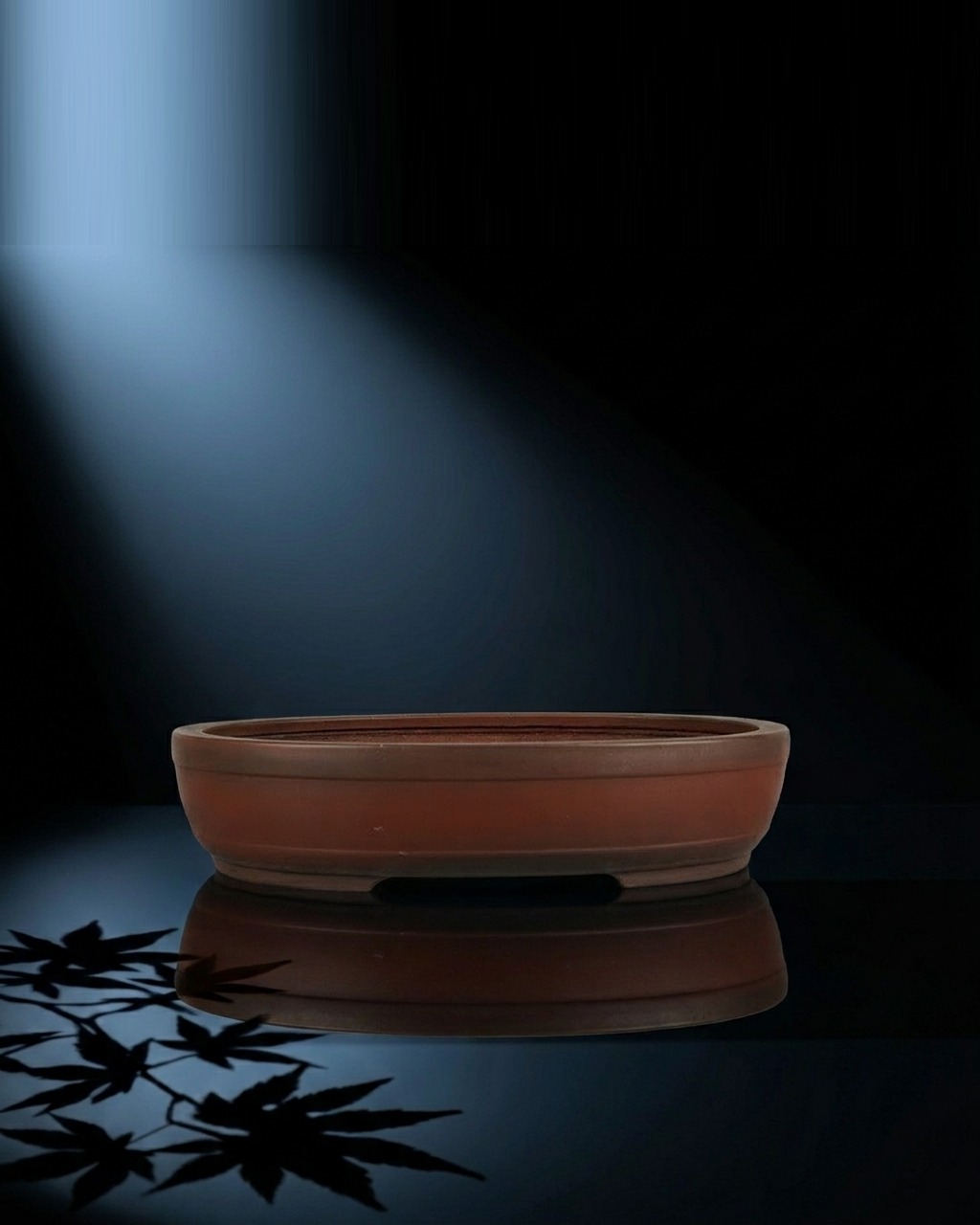
He entered the trade in 1958 and taught himself the wheel. It was eleven years before he began making pot bodies and seventeen before he had a kiln of his own. What he became known for is a small pot in softly shaded shudei.
At a glance
- Name
- Bigei 美芸
- Real name
- 平田涼美
- Born
- 1939
- Region
- Tokoname 常滑
- Into the trade
- 1958 — wheel work self-taught
- Pot bodies from
- 1969
- Own kiln from
- 1975
- Known for
- Shaded shudei small pots
- Also
- Mid-size pots; carved, pierced and inlaid decoration
01 · 年代 The dates currently known
Seventeen years to a kiln
Three dates are recorded. He came into pottery in 1958, began making pot bodies in 1969, and opened his own kiln in 1975.
What the mark alone settles about a date is not established. The years above describe his career, not the period in which the mark was used.
02 · 作行 The work
Shading, and then carving
What made his name is the small pot in shaded shudei — 朱泥ボカシ, vermilion clay. Among shōhin growers it was highly regarded. There are mid-size Bigei pots too.
The 2006 account says he had recently begun working seriously on decoration: lines cut with a point, pierced work, inlay. Its assessment of that is measured — interesting as a variation so long as it does not tip over into excess — and it reminds the reader that a pot’s real job is to set off the tree.
One technique is worth knowing by name. イブシ, ibushi, damps down the shine of the vermilion clay, which is why a new Bigei pot can already look settled.
03 · 落款 The mark
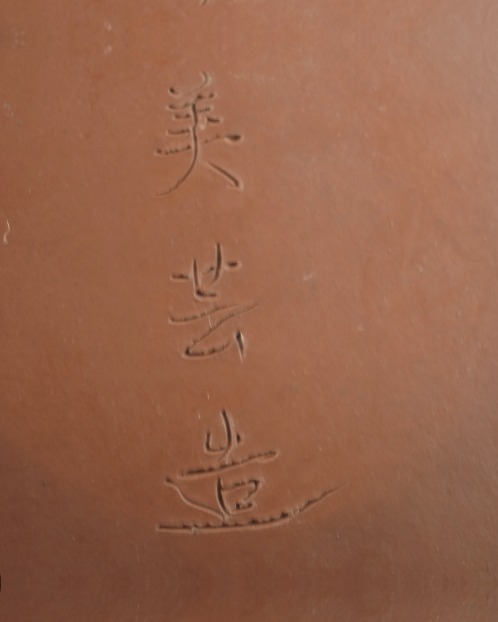
美芸造 — three characters, cut into the clay.
Cut, where the documented mark is a stamp
The base of the pot at the top of the page. Three characters, one below the next, in thin cut lines with no frame: 美芸造.
The documented mark is a stamp. It is documented here twice — once pressed into a pot and once as a clean impression — and both read 美芸.
A second pot handled by us carries just the two characters 美芸, also cut rather than stamped. Neither cut form is among those currently documented here, so the status of both remains unverified.
04 · 落款 The mark
The documented mark, and an unverified example
A stamped 美芸 mark is documented for him. A cut-line example bearing the same two characters has also been observed, but its attribution remains unverified. Other forms may exist.
| Mark | Reading | Note |
|---|---|---|
| 美芸 | Stamped — two impressions documented | Printed twice on the same page: pressed into a pot, and as a clean impression. Both captioned the same. |
05 · 代表作 Recorded works
Recorded works
Not for sale — five works recorded for this maker.
| Work | Size (cm) |
|---|---|
| Shudei rectangle, inner rim — an antique-feeling form copied from an old Chinese import. Nothing about the rim is assertive, so it takes a wide range of species and tree shapes | 15 × 11 × 3.7 |
| Shudei oval, everted rim, body band — an ordinary form with a single band added, and the position of it is the maker’s own. Deep enough to balance a tree with some weight to it | 19 × 15 × 5 |
| Shudei rectangle, inner rim, lower band, rounded corners, landscape cut with a point — the lower band balances a body that widens as it rises. The carved landscape gives the pot a face without tipping into excess, and ibushi takes the shine off the vermilion for a quiet colour | 13.5 × 10 × 3 |
| Round, dragon-in-cloud relief, bamboo-node rim — ibushi again, so it has an aged look while still new | 10 × 6 |
| Shudei oval, inner rim, studded — a fine piece at mid size. The double round of studs set just under the rim is effective decoration, and lends it some dignity | 31 × 24.5 × 6 |
Available
Bigei pots in the collection
Each pot ships worldwide from Tokyo.
Send us a photograph of the underside and we will tell you what the mark says.