Makers · 作家 · Tokoname
Hattori
服部b. 1951
He read ceramics at the Koblenz institute of technology in West Germany and worked there before beginning to make bonsai pots in 1977 — glazed, made with moulds, and in numbers that are probably the largest of any maker who does the forming, glazing and firing alone.
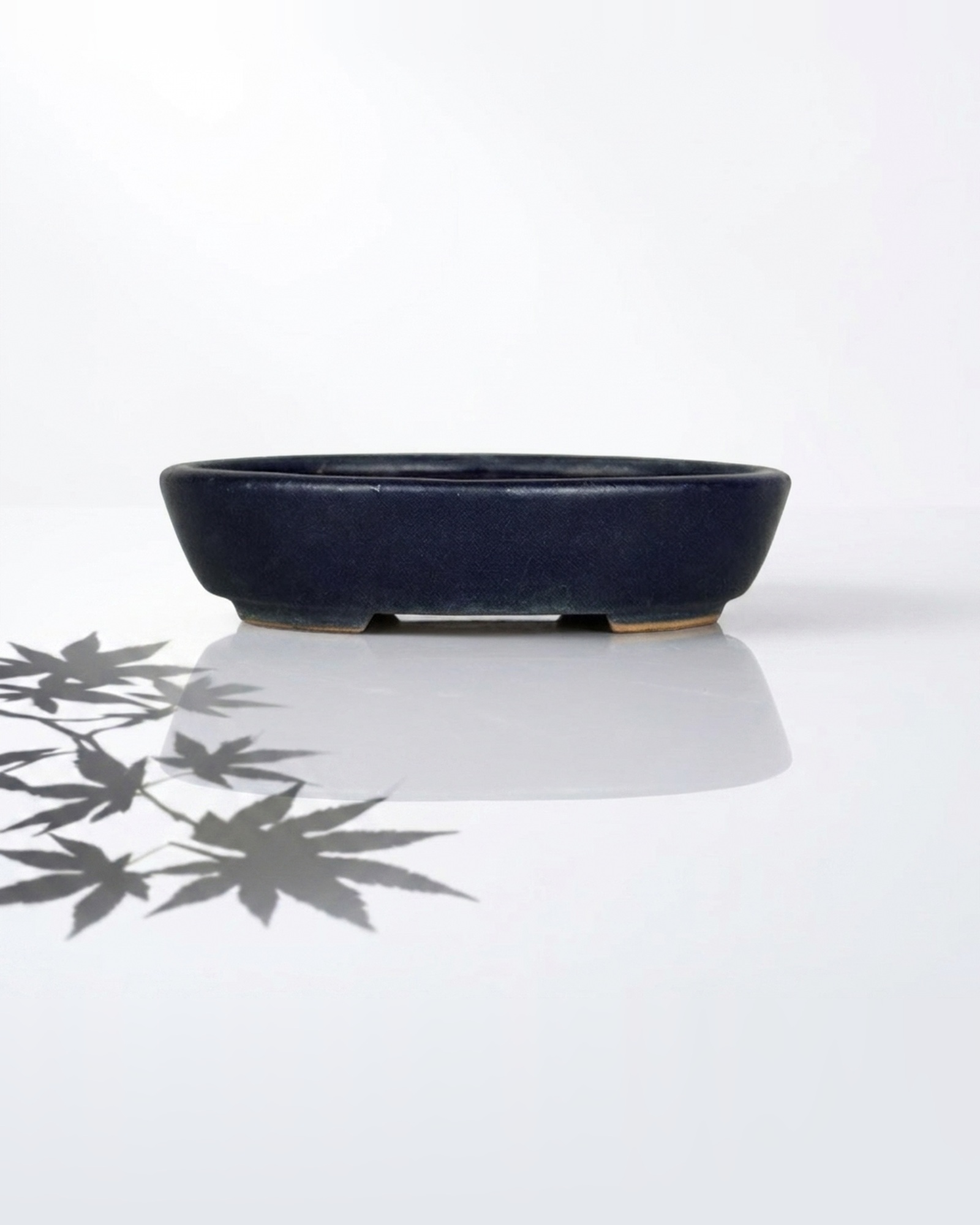
At a glance
- Name
- Hattori 服部
- Real name
- 服部知幸
- Born
- 1951
- Region
- Tokoname 常滑
- Studied
- Ceramics, Koblenz institute of technology, West Germany, then worked there
- Pots from
- 1977
- First shown
- National small-pot exhibition, 1980
- Awards
- Chōza Prize, 1998 and 1999 — two years running
- Field
- Glazed small pots chiefly, though the range runs large to small
- Forming
- Almost all made with moulds
- Forms
- Rectangle, square, hexagon, oval, round — the ordinary ones
01 · 経歴 The route in
Ceramics, in German
Hattori read ceramics at the institute of technology in Koblenz, in what was then West Germany, and worked there afterwards. The unusual route is put down to his father, who was a research scientist at Nikon.
He began making bonsai pots in 1977 and showed at the national small-pot exhibition three years later. In 1998 and 1999 he took the Chōza Prize two years running, with bonsai pots.
None of this made him academic about the work. He is described as a plain, straightforward craftsman with none of the pretension of an artist, who sets out to make pots that are good to grow in, easy to use, and that set a tree off.
02 · 釉 The glazes
An even colour, and the ones that are not
Glazed small pots are the main line of the work, and what he aims for in them is an even colour across the whole pot. The glazes are many; the forms are the ordinary ones.
Which makes one point worth knowing before you buy. Corners and rims sometimes come out of the kiln changed — 窯変, yōhen. He regards these as falling short of what he was aiming at. He ships them anyway, because some collectors are glad of them, and says so flatly.
Even colour across the whole pot — that is the aim.
03 · 落款 The mark
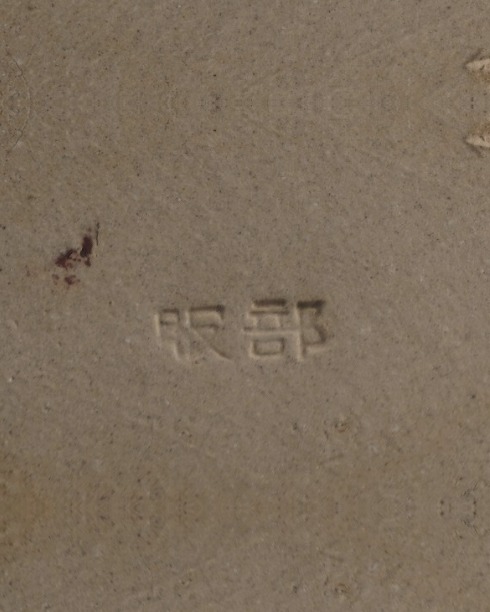
服部 — two characters, side by side.
Two characters, side by side
服部 on the base of a pot handled by us as his. Two characters set side by side, not one above the other.
The record gives his mark as 釘書, kugigaki — written into the clay with a point before firing — and prints two of them, in visibly different scripts.
Two impressions are documented for him, differing in script. Both are his.
04 · 落款 The mark
One name, two scripts
Only one name is recorded for him, and it is written rather than stamped.
| Mark | Reading | Note |
|---|---|---|
| 服部 | 釘書 — written into the clay with a point | Two impressions are documented, differing in script. |
05 · 代表作 Recorded works
Recorded works
Not for sale — nine pots recorded for this maker, in four groups. Sizes are given for the first of each group only.
| Work | Size (cm) |
|---|---|
| White-glazed rectangle, bead rim, indented corners | 12.5 × 9.5 × 4 |
| Kinyō-glazed hexagon, outer rim | — |
| Celadon-glazed round, outer rim, petalled | — |
| Ruri-glazed rectangle, inner rim, body band, indented corners | — |
| White-glazed mokkō, inner rim | 14.5 × 12 × 4 |
| Kinyō-glazed rectangle, inner rim, body band, indented corners | 40 × 30 × 9 |
| Unglazed round, enamelled — properly an autumn-grasses and flower-basket design: the basket worked together with shiori-ume plum motifs and fan shapes, laid straight onto the polished unglazed surface | 13.7 × 7.1 |
| Purple-red glazed octagon, outer rim — encouragement prize at the first Contemporary Small Pot exhibition, January 2006 | — |
| Unglazed, petalled | — |
Available
Hattori pots in the collection
Each pot ships worldwide from Tokyo.
Send us a photograph of the underside and we will tell you what the mark says.