Makers · 作家 · Mino
Sekishu
市之倉石州1925–2006
Two names on one kiln's pots: under a hundred pots a year, he judged, and he could sell them himself rather than through the trade.
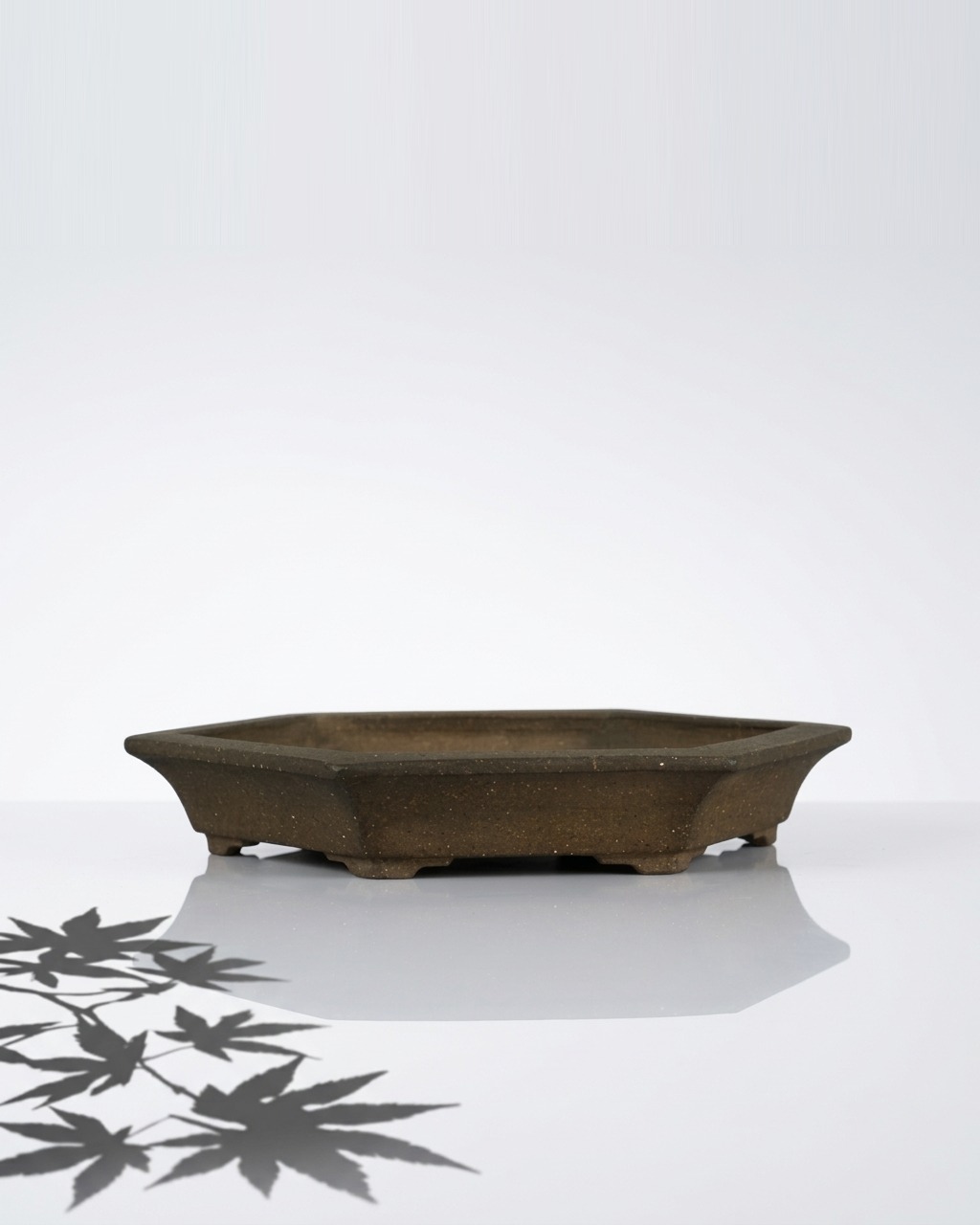
At a glance
- Art name
- Ichinokura Sekishū 市之倉石州
- Real name
- 水口元夫
- Dates
- 1925–2006
- Region
- Ichinokura, Tajimi — Mino
- 1955
- Set up on his own as the Kōhō kiln 光峰窯, making sake and tea wares
- From about 1970
- Bonsai pots — moulded, in numbers. These are the 光峰 pots
- From about 1972
- Hand-made, one at a time. These are the 市之倉石州 pots
- Output
- Under a hundred hand-made pots a year. Painted pots, about three hundred in fifteen years
- Range
- From bean pots under a centimetre to 60 cm
- Successors
- 水口修・悦子
01 · 二銘 Two names
Why he split the name
The reason for the split was practical, and his own reckoning lies behind it.
He set up on his own in 1955 and made sake cups and tea wares. Bonsai pots came about 1970, moulded and made in numbers — cheap, easy to use, and well liked. Those are the 光峰 pots, and the name is the kiln's.
Then he grew uneasy about how opaque the distribution had become. From about 1972 he began making pots by hand, one at a time, and those are the 市之倉石州 pots.
The reasoning is recorded, and it is a working potter's reasoning: at under a hundred pots a year, he judged, he could sell them directly himself.
At under a hundred pots a year, he judged, he could sell them himself.
So the two names mark two things at once: how the pot was made, and how he meant to sell it.
And they are not exclusive. One pot is identified as a joint work, 石州・光峰合作, and a boxed pot can carry both names: one example has 市之倉窯 石州 written on the cloth and 光峰 on both the box lid and the foot.
02 · 技法 The techniques
Porcelain inlay, and raised enamel
He was keen on new techniques and diligent in research.
Beyond ordinary glazed pots he worked in underglaze blue, in overglaze red, in cockscomb red, in relief carving. Two techniques are singled out as his own ground: inlaying white porcelain clay into a stoneware body, and painting in raised enamel.
Of the inlay the note is practical — difficult, slow, and therefore very few of them exist. His cockscomb red is also very scarce.
From about 1979 he added unglazed clays as well: white, purple, coarse purple, vermilion, black, pear-skin. The range runs from bean pots under a centimetre to pieces 60 cm across.
03 · 数 The numbers
Three hundred painted pots
His main business — the sake cups and tea bowls, made in numbers — was doing well, so the pots were made in the gaps. The total number is small.
For the painted pots there is a figure: across about fifteen years of working at them hard, some three hundred in all.
Three hundred, over fifteen years. That is the scale to have in mind before believing any attribution.
Three hundred painted pots, over about fifteen years.
In 2006 he had around twenty pots formed and painted, waiting only to be fired, and meant to finish those before starting anything new. A collaboration with his successors, 水口修 and 悦子, was being planned.
04 · 石州 The hand-made name
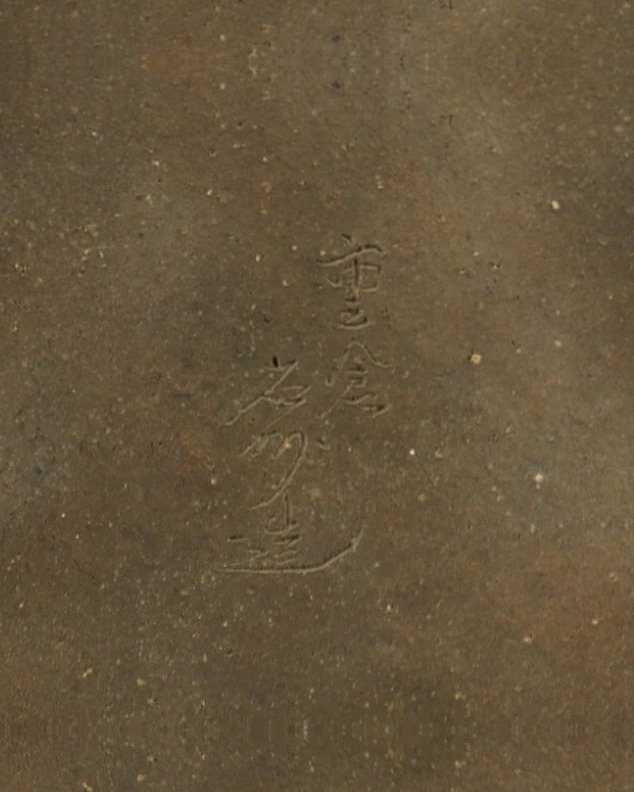
市之倉石州造 — cut into the bare clay with a point.
The mark on a hand-made pot
The foot of the pot above. 市之倉石州造 — made by Ichinokura Sekishū — six characters in two columns, in a flowing hand.
Written, not stamped. The characters are cut straight into the unglazed clay with a point, freely and without a frame — nothing is pressed in. The documented 市之倉石州造 is the same wording set inside an upright panel on a light ground; this one is cut straight onto the bare foot.
This is the half of the output this page is about. A written 市之倉石州 means one of under a hundred pots a year. A 光峰 mark means the other line, and a different kind of pot.
05 · 落款 The mark
Four documented marks, and what each is
Four are documented. Two of them are written by hand rather than stamped.
| Mark | Reading | Note |
|---|---|---|
| 市之倉石州造 | Incised, in an upright panel | Cut into a light ground. |
| 市之倉石州 | Written by hand | A brushed signature, not a stamp. |
| 市之倉石州造 | A round stamp on lapis ground | Pressed, on a ruri ground. |
| 石州造 | Written by hand | Brushed straight onto the body. |
Kōhō is not Kōyō
光峰 here is Mino, and it is a line rather than a person. It is Kōhō, and so are 幸峰 and 好峰. 鴻陽 of Tokoname is Kōyō — a different reading, and a different maker.
06 · 代表作 Recorded works
Recorded works
Not for sale — twenty works recorded for this maker. Nearly all of them are small: most sit between 7 and 10 cm.
| Work | Size (cm) |
|---|---|
| Stoneware with porcelain inlay, birds and flowers in underglaze blue — rectangle, everted rim | 9.8 × 8 × 5 |
| Stoneware with porcelain inlay, a landscape in underglaze blue — shitagata, everted rim. Chinese literati manner, a scholar calling on a friend at his gate; the bamboo is softly done. A verse from the Man’yōshū runs along the side | 8 × 8 |
| Unglazed, a rising dragon — round, rope rim. Made jointly. Catalogued as 石州・光峰合作 | 8.6 × 4.8 |
| White glaze with enamel, after the Chōjū-giga scrolls — rectangle, inner rim. The reverse has a frog shying at a will-o’-the-wisp | 13.7 × 9.8 × 4.5 |
| Underglaze blue with enamel through a window, after the same scrolls — square, outer rim. The window panels are a close-worked blue landscape, set against the sparing, comic animals | 9 × 5.5 |
| Underglaze blue, a landscape — shitagata, everted rim. Almost the same form and size as the inlaid one above, and it reads quite differently | 7.8 × 8 |
| Overglaze red, loose horses — rectangle, outer rim | 8.9 × 6.9 × 4.2 |
| Underglaze blue, a landscape — square, inner rim | 7.5 × 8.4 |
| Enamel through a window, an ox carriage — round, everted rim. The body is filled with the seven-treasures pattern and the window left white for carriage, cherry and maple; gold dust is scattered in the ground. The reverse is a phoenix | 8.8 × 6.8 |
| Celadon with carved flowers, a landscape — round, outer rim | 8 × 6 |
| Celadon with copper red run over it — round, everted rim. Thought to be after a noted Kotō-ware piece; the red carried down to the waist as well is the modern touch | 8.2 × 5.2 |
| Green glaze — outer rim, ancient-mirror form | 18 × 5.8 |
| Green glaze, hand-built — round, outer rim | 8 × 4 |
| Cockscomb red — rectangle, shamisen-body form. His cockscomb red is well thought of, and there is very little of it | 8.9 × 6.8 × 3.4 |
| Ruri glaze — oval, bag form | 14 × 11.3 × 2.8 |
| Unglazed — rectangle, outer rim. A small pot, but his unglazed work runs wide and goes up to nearly two shaku | 18.8 × 15.3 × 4.2 |
| Unglazed, bamboo-node band — rectangle, inner rim | 7.6 × 5.9 × 3 |
| Unglazed — round, drum form, inner rim | 19.2 × 4.9 |
| Unglazed with figures in relief — oval, outer rim. Small tablets of clay applied after forming and then carved, with the four scholarly accomplishments on them. His unglazed pots are fairly numerous; this one is not | 17.3 × 13 × 3.8 |
| Unglazed, a landscape painted in coloured slip — oval, outer rim. Thought to be after the Chinese painted udei and shidei pots | 17 × 13 × 3.8 |
07 · 窯 The kiln now
He died in 2006. The kiln did not
Two facts, and they have to be given together or one of them turns into a lie.
His death is recorded in an editor's note: November 2006, aged 81.
In 2024, the kiln was recorded as operating as 光峰窯 水口製陶所.
So: pots from his own hand are finite, and there will be no more of them. Pots from the kiln are not. We say both.
Pots from his own hand are finite. Pots from the kiln are not.
Available
Sekishu and Koho pots in the collection
Each pot ships worldwide from Tokyo.
Send us a photograph of the underside and we will tell you what the mark says, and whether it matches a form documented here — which is the first thing to settle with this kiln.