Makers · 作家 · Tokoname
Yamafusa
山房A Tokoname kiln rather than a person. Its marks divide the work in two ways at once — by grade and by era — and all five of the pots recorded for it are glazed.
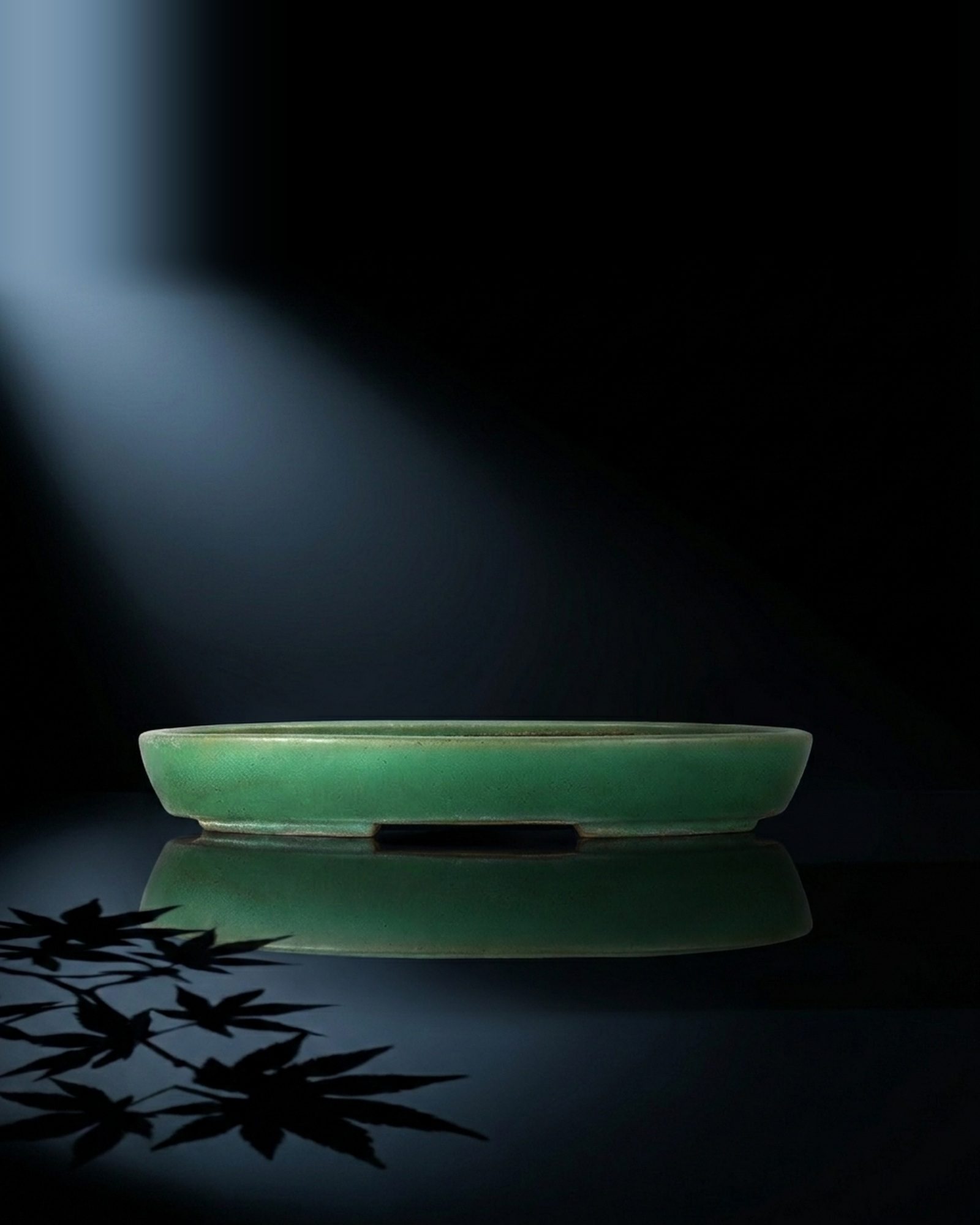
At a glance
- Name
- Yamafusa Pottery 山房鯉江製陶所
- Potter
- 鯉江一房
- Region
- Tokoname
- Not a person
- Yamafusa is the kiln. The pots are its output, not one man’s signature
- Earlier forming
- Mainly press-moulded production ware
- Until the mid-1980s
- Production ware — sound, affordable Tokoname glazed pots
- From the mid-1980s
- Finished to a higher standard and aimed at the top of the market
- Forms
- Over fifty standard shapes; hundreds counting glazes and sizes
- Glazes
- Ruri, kinyū, namako, oribe, white — and white kōchi
01 · 落款 The marks
Two grades, and the mark that replaced them
Four marks documented here help distinguish periods and lines of work.
山房造 went on the production ware. 山房鳳舟 and 山房造風亭 went on the premium line. In recent years these appear to have been unified under a single 山房造印 — with that reservation.
So the mark on an older Yamafusa tells you the grade. On a newer one it tells you the era instead, because the grades no longer show. Either way you learn something the pot itself will not volunteer.
On an older pot the mark gives you the grade. On a newer one, the era.
Other kilns use their marks the same way, for different distinctions. Yamaaki separates handmade from production, and Gyōzan Nakano separates slab-built from moulded. Neither of those readings applies to Yamafusa’s marks.
02 · 転換 The turn
The middle of the 1980s
Before it, the kiln was liked for press-moulded production pots: sound, affordable, Tokoname glazed ware that people were glad to grow in.
From about the middle of the 1980s the finishing became the point, and the kiln went after the top of the market. The word for what has come out since is steady — an even standard, pot after pot.
The same goes for the glazes. For a Tokoname kiln, Yamafusa is reckoned to keep its range narrow: ruri, kinyū, namako, oribe, white. Over fifty standard forms, and hundreds of variants once glaze and size are counted — but not an unlimited palette.
03 · 釉 The glazes
All five recorded pots are glazed
This is worth stating flatly, because an unsourced description said the opposite — that the kiln works mainly in unglazed clay. The record does not bear that out.
The glazes named for Yamafusa are all glazes, and all five of the recorded pieces are glazed pots — lapis, oribe, white kōchi, kinyū, namako. The record names no unglazed ware for it.
One of those five carries a useful detail. The small namako rectangle, twenty centimetres across, is recorded as having been sold under the old 山房鳳舟 mark — which ties a particular pot to a particular mark, and the mark to the premium line.
04 · 落款 The mark
Four documented marks, three of them from the earlier lines
The first is the one in use as of 2006. The other three tell you where an older pot sat in the range.
Only the first has an impression documented here. The other three are known by wording only, and nothing shows how they look on a pot.
| Mark | Reading | Note |
|---|---|---|
| 山房造印 | A square stamp — impression documented | Recorded in 2006 as the mark the older ones appeared to have been unified under. |
| 山房造 | Named in text only | The older mark on the production ware. |
| 山房鳳舟 | Named in text only — Hōshū | The older mark on the premium line. One recorded pot carries it. |
| 山房造風亭 | Named in text only, with 風亭 | The other older premium mark. |
What the current mark hides
By 2006 山房造印 appeared to cover everything. The grade distinction the older marks carried is no longer shown.
05 · 代表作 Recorded works
Recorded works
Not for sale — works recorded for this kiln. All five are glazed.
| Work | Size (cm) |
|---|---|
| Rectangle, inner rim, straight sides, indented corners — ruri. A common medium-shallow form, versatile and suited to a wide range of trees; the corners are finely softened, and the blue is even. It brightens when new and settles as it is used | 47 × 33.3 × 7.2 |
| Rectangle, inner rim, body band, rounded corners — a quiet oribe, with the band giving it some movement. To get the best of the colour, plant something that opposes it — flower, fruit or autumn leaf | 47 × 35 × 10 |
| Oval — white kōchi, and close to two shaku across. A size for a clump or a group planting | 55.7 × 40 × 6 |
| Oval, bead rim — kinyū. Very simple, and with a dignity inside that simplicity; a glaze you can use for broadleaf without a second thought | 46 × 35 × 10 |
| Rectangle, rounded corners — namako, sold under the old 山房鳳舟 mark. A small pot; today it would count as a shohin or kifu size. Its violet-red flecking is described as what kinyū gives of its own accord, and it is set against the even colour of the kinyū oval above — which of the two you prefer is a matter of taste | 20 × 15.5 × 5.5 |
Available
Yamafusa pots in the collection
Each pot ships worldwide from Tokyo. Send us a photograph of the underside and we will tell you what the mark says, and whether it matches a form documented here.