Makers · 作家 · Tokoname
Zengo
銭号Recorded in 2006 as one of the kilns that have been making bonsai pots in Tokoname the longest. Its proper name is the Izumiya kiln; Zengo is a nickname, and it comes from a misreading of the mark. The mark itself is a misreading of a different kind — it is Chinese, and it was copied.
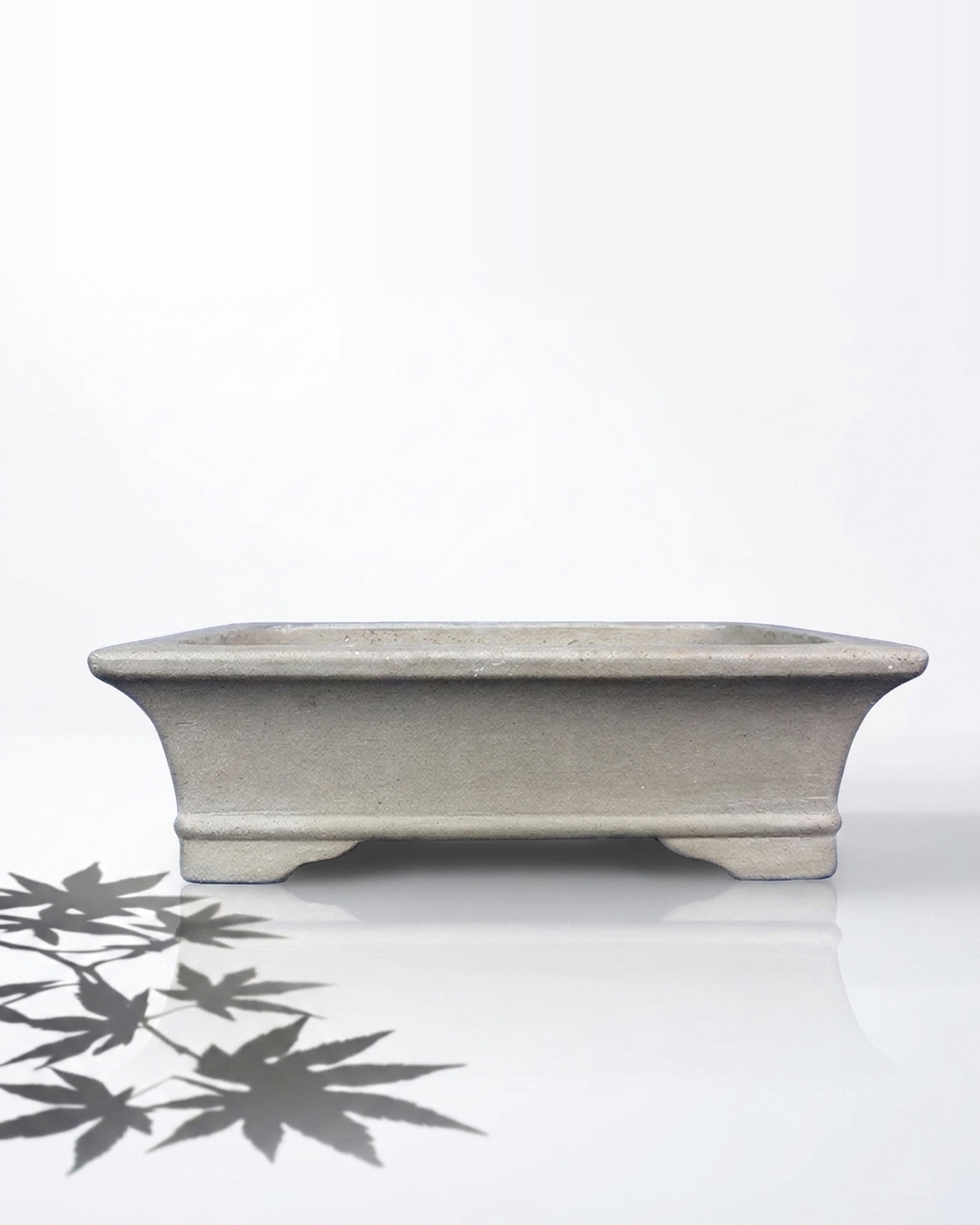
At a glance
- Trade name
- Zengo 銭号 — a nickname
- Proper name
- Izumiya kiln 和泉屋窯
- Workshop
- Izumiya pottery 和泉屋製陶所
- Potter
- 松下益久
- Region
- Tokoname 常滑
- Standing
- Among the oldest bonsai-pot kilns in Tokoname
- Body
- Almost entirely unglazed
- Clays
- Shidei chiefly, and Tokoname udei
- Moulds
- An old kiln, so a deep stock of forms
01 · 落款 The mark
A Chinese mark on a Japanese pot
This is the thing to know before you buy.
The mark documented for the kiln reads 銭子窯製. It began as the mark of a Chinese pot of the middle import period. Before the war, when Tokoname kilns were making copies of Chinese ware, they copied the mark along with everything else — and this one stayed. 秘色窯 is named as another Tokoname example of taking an old Chinese kiln name as one’s own.
So the mark is not evidence that a pot is Chinese. It is a Tokoname kiln’s mark.
The mark is not evidence that a pot is Chinese.
02 · 通称 The nickname
Why anyone says Zengo at all
The mark is in seal script, and in that script the character 子 can be taken for 号. The nickname settled from that misreading, and the trade has called the kiln Zengo since.
The conclusion drawn is a reasonable one: a kiln picking up a nickname at all is taken as a sign of how well known it was.
One more name to keep straight. There was a second Izumiya pottery in Tokoname, the 松萱窯. As of 2006 it had suspended pot production.
03 · 実物 The mark on a pot
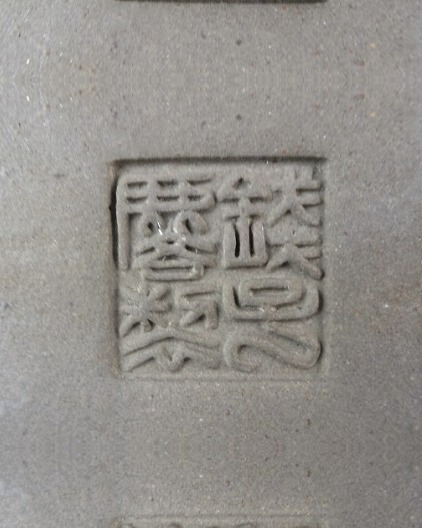
A square seal, the characters standing proud of the clay.
A square seal, raised, in seal script
On the base of a pot handled by us as Zengo. A square frame with the characters raised rather than sunk, in seal script.
This is the shape of the thing that causes the confusion. A square seal in seal script, on an unglazed clay pot — and it looks like that because it was copied from the mark of a Chinese pot.
The mark recorded for the kiln is 銭子窯製, a square stamp in seal script.
04 · 実物 A second pot, a second observation
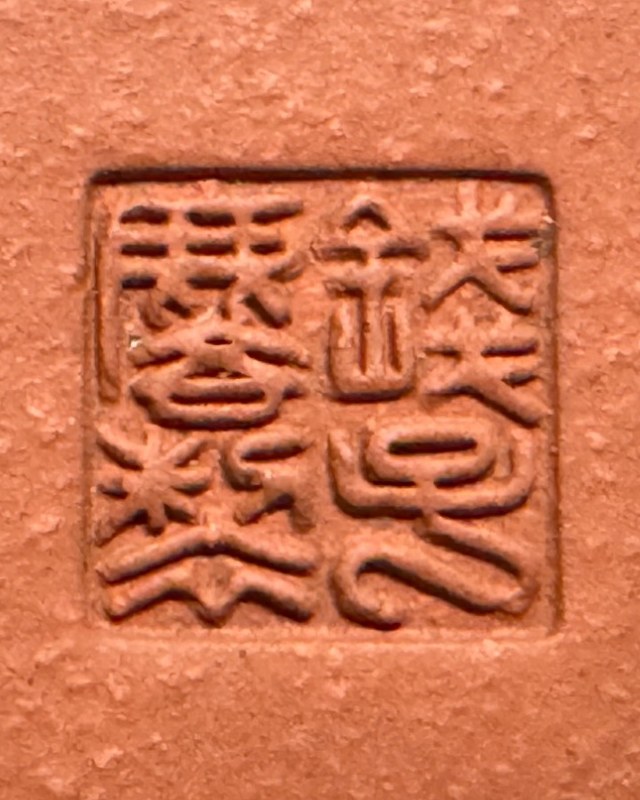
Red clay, unglazed. A 15.2 cm rectangle.
The same square seal, on red clay
Photographed on 11 November 2026 on the base of a second pot, a 15.2 cm unglazed rectangle in red clay, a different clay from the grey pot above. The kiln is recorded as working chiefly in shidei; this pot is shudei, which is what we observed.
The form matches the first example: a square stamp, the characters raised, in seal script, set in two columns of four. Two pots is two observations, not a rule. We record what we have seen and do not say that this is the only form the kiln used.
05 · 落款 The mark
One documented form
A square stamp in seal script. This is the form currently documented here for the kiln; it is not a claim that the kiln used no other.
| Mark | Reading | Note |
|---|---|---|
| 銭子窯製 | A square stamped mark in seal script | Originally the mark of a Chinese pot of the middle import period, copied before the war and kept. |
A mark is not a passport
Do not read this mark as proof of Chinese origin. The record states plainly that it was copied from Chinese ware by Tokoname kilns.
06 · 土目 The clays
Shidei, and the smoked black
The kiln works almost entirely unglazed, and being an old one it has a deep stock of moulds. The clay is chiefly shidei, the purple-brown zisha.
The other one is worth learning. Tokoname’s udei is called イブシ, ibushi, locally, and the point made about it is that it looks settled straight out of the kiln — a new pot that does not look new.
Sizes run from small to large. As of 2006 the small and mid sizes were the ones in demand.
07 · 代表作 Recorded works
Recorded works
Not for sale — seven pots recorded for this kiln, in three entries. The first two entries are sets of three.
| Work | Size (cm) |
|---|---|
| Udei rectangle, outer rim, indented corners — one of a set of three in nearly the same form and much the same size. A set like this lets you match a pot to a tree by fine degrees | 15.5 × 12 × 6 |
| Udei rectangle, outer rim, indented corners — the second of that set | 18.5 × 14 × 7.5 |
| Udei rectangle, outer rim, body band — the third | 19 × 14.5 × 6 |
| Shidei rectangle, outer rim, indented corners — the first of a second set of three, in a quieter clay than the set above. Sets in one form and several sizes exist too, and they are useful | 19 × 14.5 × 5.5 |
| Shidei rectangle, everted rim — the second | 19 × 14.5 × 6 |
| Shidei rectangle, body band, rounded corners — the third | 19 × 15 × 5 |
| Udei mokkō, outer rim — mid size. The outer rim looks strong with the pot on its own, and stops looking so once a tree is in it; the form takes more than you would expect. Not for the formal manner — an upright trunk, or a thick trunk with a quiet figure — but right for something a little more relaxed | 40 × 33 × 13 |
Available
Zengo pots in the collection
Each pot ships worldwide from Tokyo.
Send us a photograph of the underside and we will tell you what the mark says — and, with this kiln, what it does not mean.