Places · 瀬戸
Seto
Where Japanese ceramics became setomono
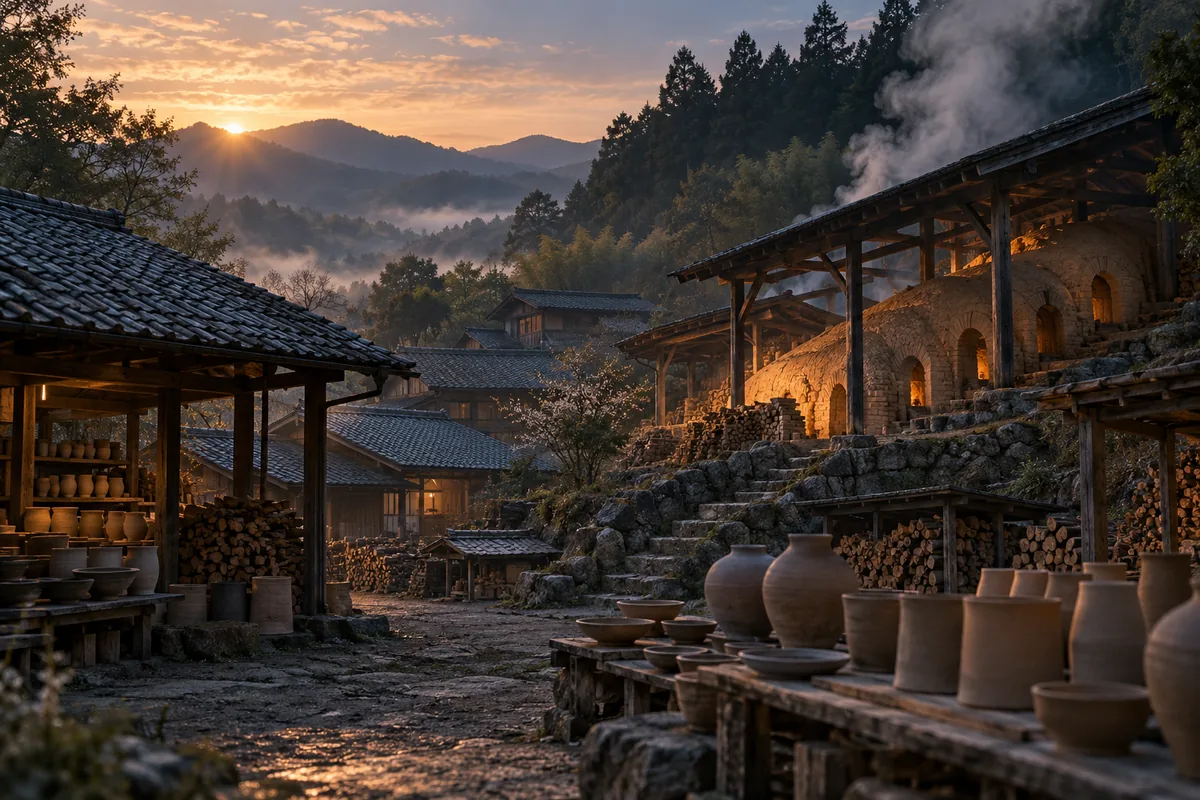
Seto ware comes from the ancient kilns of Seto, whose name became the everyday word setomono for pottery in much of Japan. Seto bonsai pots include the Owari blue-and-white pots.
In much of Japan, from the old capital region eastward, the everyday word for pottery and porcelain is setomono — “Seto things”. This page follows that town’s kilns from ancient times to the porcelain revival of 1807, and then to the bonsai pots made in and around Seto: who commissioned them, who formed them, who painted them, and what their marks can and cannot tell you.
00 · At a glance
Seto, in four points
Place
Owari, now Aichi
Seto lies in the old province of Owari. It had good clay and other ceramic materials close at hand, and potters there were firing ware as far back as the Nara and Heian periods.
Turning point
1807
A potter, 加藤民吉 (Katō Tamikichi), brought porcelain-making back from Hizen and Arita. Seto rose again as a great porcelain centre.
Bonsai pots
Mostly after 1807
Pots may have been made in the earlier pottery tradition too, but hardly any are seen. Most Seto pots handed down among bonsai growers are from the porcelain era or later.
How they were made
Many hands
The Tōsui story shows how one pot could involve a dealer who commissioned the design, a kiln that formed and fired it, and a painter who decorated it.
01 · 瀬戸焼の歩み
From ancient kilns to the porcelain revival
Seto’s story is a long one, and it is not a straight line. The town rose, faded and rose again, and the second rise is the one that matters most for bonsai pots.
-
Nara and Heian periods
Sueki stoneware
Seto, well supplied with ceramic materials, was already firing sueki, the grey unglazed stoneware of ancient Japan.
-
Late Heian period
Ash and green glazes
At kilns such as the Sanage kilns, potters made ash-glazed and green-glazed wares under the influence of Chinese Yue celadon. Everyday ware was mostly cheap, unglazed and made in quantity; ash-glazed ware was made in small numbers at kilns of the Higashiyama line. That glazed ware is what is called Ko-Seto, “old Seto”.
-
Kamakura to Nanbokuchō
The great glazes
An amber ame glaze developed, traditionally credited to 加藤藤四郎景正 (Katō Tōshirō Kagemasa), remembered as the founder of Seto pottery. High-grade glazed wares followed: tenmoku, kin-nagashi and celadon glazes.
-
Momoyama period
Mino and the tea masters
Ki-Seto, Shino and Oribe, which grew up in neighbouring Mino, belong to the same stream, helped along by tea masters who found beauty in Seto wares. In the broad sense, Mino ware is counted as part of Seto ware.
-
Edo period
Decline
As porcelain began to be fired in other regions, Seto’s kilns were left behind and declined quickly.
-
1807
Porcelain comes to Seto
加藤民吉 learned the methods of porcelain-making in Hizen and Arita and brought them back, with support from the Owari domain among others. For this he and his backers were granted the right to a surname and a sword, and rewarded. Seto came to call him the father of porcelain.
Seto has two words for the two halves of its history. Hongyō 本業, “the original trade”, is the pottery made before Tamikichi. Shinsei 新製, “the new make”, is the porcelain that came after him. Both words come back when you look at a Seto bonsai pot.
02 · 盆器のはじまり
When did Seto start making bonsai pots?
Carefully put: we do not know exactly. Pots for plants may well have existed in the hongyō period, but hardly any are seen. The Seto pots handed down in the bonsai world are, for the most part, shinsei porcelain or later.
That gives a working rule of thumb, not a law. A Seto bonsai pot is usually from 1807 or after. It does not mean that an individual pot can be dated from its region alone.
A documented pot shows how this looks in practice. A blue-and-white rectangle painted with birds and flowers carries a painted mark on its base: 日本瀬戸 加藤桑次郎製 — “Japan, Seto, made by 加藤桑次郎”. Its maker set up on his own making blue-and-white ware, also exported high-grade Seto porcelain, and died in 1887. A mark of that kind can anchor a pot to a maker and a time; most pots are not so obliging.
03 · 土・焼成・釉
Clay, fire and glaze
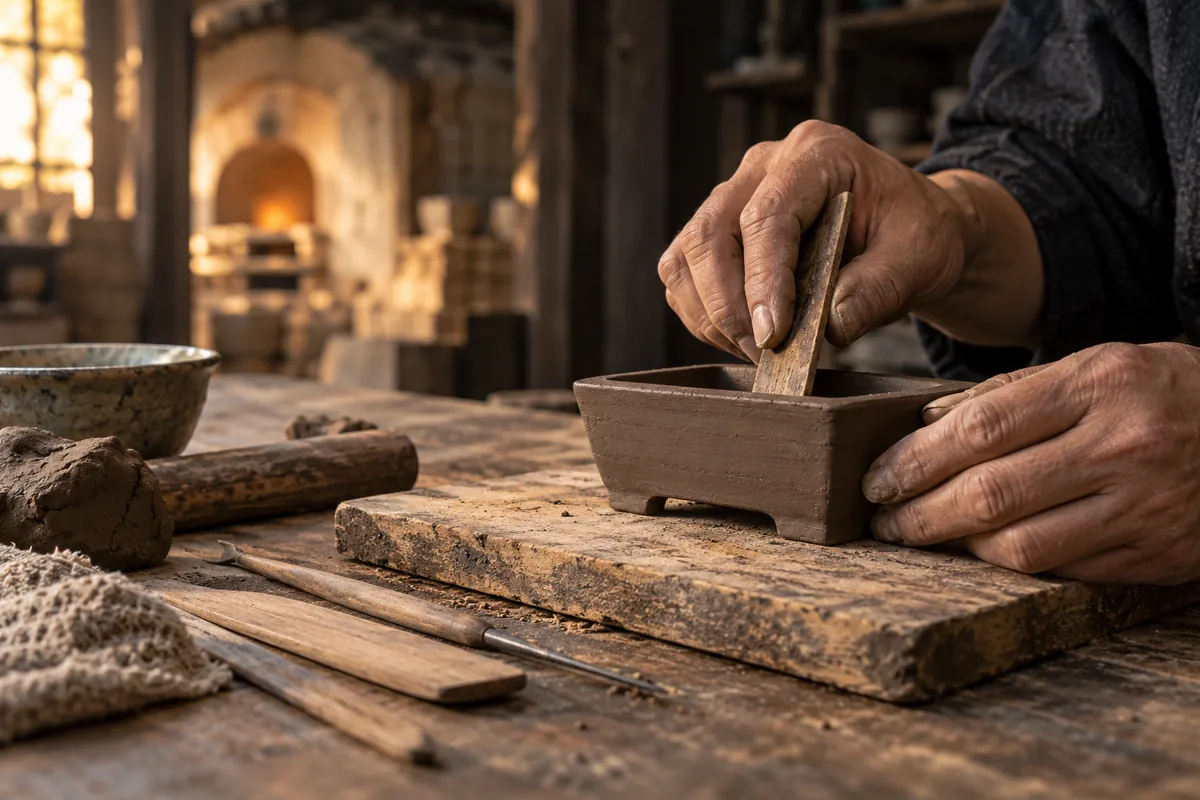
Seto works in both pottery and porcelain, and Seto bonsai pots come in both. The points below are drawn from documented pots and makers. They describe what has been recorded, not every pot that left the town.
Body
Pottery and porcelain
Hongyō pottery came first; shinsei porcelain came from 1807. Some pots sold under the Tōsui name have a porcelain body. The maker Mazan blended a refractory Seto clay with clay from Tokoname and from China.
Fire
High and even
Maruzen’s large porcelain water trays were fired without warping or distortion. Mazan fired his clay bodies in a gas kiln at about 1200°C, high for pottery.
Glaze
From amber to Oribe
Seto’s glazes run from the old amber, tenmoku and celadon to Oribe green, namako, Jun-type kin’yō, soba, ruri blue, yellow and a red keiketsu glaze on bonsai pots and water trays.
Decoration
Blue, enamel and relief
Underglaze cobalt blue (sometsuke), overglaze enamels, applied relief, openwork and carved or painted panels all appear on Seto pots.
Forming
By hand and by mould
Both handmade and slip-cast pots were made. Mazan made moulded plant pots before turning to handmade bonsai pots around 1985.
A Seto speciality
Colour in the body
One Maruzen method, called neriage-de, is said to work colour into the body itself and fire it under a clear glaze.
04 · 尾張焼・御深井焼
Owari and Ofuke: the domain kilns
Within Seto ware there is a strand made for the lords of Owari. Ofuke ware 御深井焼 was the garden kiln of the Owari domain, named after the Ofuke-maru, an outer enclosure of Nagoya Castle where it stood. Owari ware 尾張焼 covers Ofuke ware together with pieces that the domain had delivered from private kilns it protected and treated almost as its own.
-
1616
The kiln opens
The Owari Tokugawa family set up the kiln, partly to protect a local industry. It ran, with a break, until 1871.
-
Early years
Sobokai clay, dark glaze
Refined pieces were made in 祖母懐 (sobokai) clay, which private digging was forbidden to touch, and the main glaze was a dark brown in the old Seto manner.
-
Middle years
Ofuke celadon
A special sobokai glaze, also called Ofuke celadon, came into use, along with copies of Annam (Vietnamese) ware.
-
Revival
Owari shinsei
After a break, the kiln was revived under the tenth lord, 斉朝, and made Owari porcelain. Pieces marked 御深井 are said to date from after the revival.
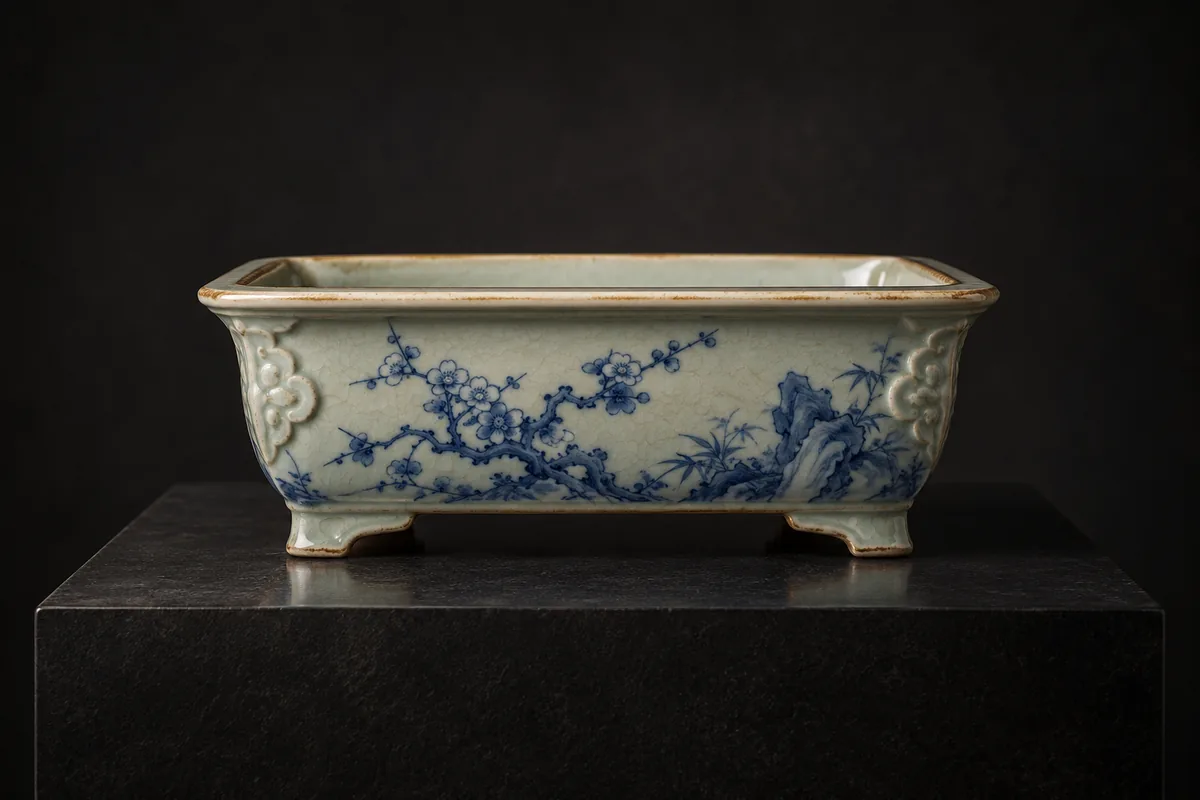
For bonsai growers, Owari means blue and white. The Owari pots handed down in numbers are chiefly underglaze-blue porcelain, some with relief or openwork. The cobalt was a costly, high-grade pigment that the domain brought in from China through Nagasaki. Private kilns could hardly afford it; a domain kiln, making gifts for the shogunate, could. What the pots share is a deep cobalt and the whiteness of a carefully chosen porcelain body.
Technique
Applied relief
Motifs are pressed from clay in a mould and applied to the body. Everything except the motifs is painted over in cobalt, then the whole pot is glazed clear, so the relief stands out white against the blue.
Pattern
Mugiwara-de
“Straw-stripe” ware: many vertical lines run down the pot. The name comes from early, rough lines that looked like straw. Some are in one colour; others mix brown, yellow or red lines into the blue or black.
Forms
Old shapes and new
Ishidai planters, a form that goes back to medieval vessels; orchid-pot shapes in use since the Genroku era (1688–1704); and — probably near the end of the Edo period — strikingly new designs.
Caution
Owari or Imari?
One fine blue-and-white pot has been attributed by some to old Imari; its style and period suggest Owari porcelain instead. Style and period can point one way; they do not settle it.
05 · 盆器を支えた人々
Dealers, kilns and painters
Some of Seto’s best-documented bonsai pots passed through several hands. A dealer might set the design, a kiln form and fire the pot, and a painter decorate it, with each name appearing in a different place on the finished piece. The names below are grouped by those roles.
Maruzen — Kōbō Maruzen 丸善・弘法丸善
Porcelain water trays known as Maruzen, or Kōbō Maruzen, have long been prized as working trays. Strictly they are the work of the third 加藤善次.
The first of the line made tea wares and figures, among them more than two thousand images of Kōbō Daishi, some of which he gave to temples in Owari — hence the nickname. The second turned to porcelain around 1846 and made his name with teapots. The third began making water trays around 1890 under the mark 善, in white, ruri blue, indigo and five-colour sets. He too revered Kōbō Daishi, and is said to have chanted the saint’s name throughout the firings, believing that a pot is not made by human skill alone. Large trays from the late Taishō and early Shōwa years, fired true, are thought to mark the height of Maruzen work.
Marukei and Marutora 丸慶・丸寅
Other Seto trays carry other trade names. Marukei trays are mostly white porcelain; who made them and when is not known, though they may be of Maruzen’s time. Documented marks include 梅鶴園 and 慶. Marutora was the Seto potter 川合寅次郎, who founded his business in 1924 at the age of thirty-seven and made oval and rectangular trays among others. A documented mark is 寅.
Tōsui: a dealer, a kiln and a painter 陶翠
Tōsui names and marks appear across several periods and participants. The core roles can still be separated. Tōsui was the brand of a Tokyo pot dealer, 植松長太郎 (Uematsu; 1899–1959), trading as 長 (Yamachō). He commissioned pots of his own design from regional kilns. One of his suppliers was Shunshō Tōen 春松陶苑 at Shinano 品野 in Seto, founded by 水野作太郎 between 1897 and 1906. Uematsu paid for a new workshop there, and from then on treated it almost as his own kiln.
Shunshō Tōen was in the hands of the Mizuno brothers. The elder, Shunshō II, ran the kiln rather than making pots himself. The younger, 水野正雄, trained in pot design under Uematsu in Tokyo until 1938, then came home. For about four years, until the war stopped production, the brothers sent out pots under Uematsu’s designs and direction, marked Shunshō, Tōsui and related seals, alone or together.
The Tōsui years
-
Wartime
A wartime interlude
With Shunshō Tōen idle, Uematsu evacuated to Warabi in Saitama, brought in craftsmen and made a small number of pots from local clay. The few that survive are sometimes called 早蕨陶翠.
-
1953
Production resumes
Shunshō Tōen started making pots again, issuing them under single Tōsui marks.
-
After Uematsu’s death
Mizuno Tōsui
水野正雄 left Shunshō Tōen, set up his own kiln, took the name Mizuno Tōsui and went on using the same marks.
-
1964
Rokujuan Tōsui
At sixty he renamed himself Rokujuan Tōsui 緑寿庵陶翠 and from then on added an incised 緑寿庵 above the Tōsui mark on every pot.
-
1970
The work ends
A stroke ended his pot making, and with it the Rokujuan mark.
Asai Chazan 浅井茶山
Asai Chazan (1904–1992), also called Shinano Chazan, did most of the carving and painting on Tōsui pots before and after the war. Born 浅井要四郎, he was apprenticed after primary school to a painter of designs for Arimatsu tie-dyed kimono, and later studied ceramic history, tea, painting and haiku. He met Uematsu around the mid-1930s and began painting Tōsui pots. Asked to paint carefully even if one piece took a whole day, he worked mostly on small pots. After the war he was prolific, and pots painted by him with other makers are also known, including Tsukinowa Yūsen. The name Chazan comes from his haiku name; it was first read Sazan. In later years he also made and painted pots of his own.
Mizuno Shikao 水野嗣賀男
Mizuno Shikao (born 1942), son of Rokujuan Tōsui, studied ceramic painting under Chazan for three years and trained in pot making under his father. His painted Tōsui pots range from landscapes, figures and bird-and-flower subjects in the literati manner to sets such as the Fifty-three Stations of the Tōkaidō and the Thirty-six Views of Mount Fuji.
Shunshō Tōen across generations 春松陶苑
After Shunshō II, the kiln passed to his son, Shunshō III. Around 1983, after the zodiac sign of his birth year, he took the name Rokumisai Shunshō 緑巳斎春松 and concentrated on one-off handmade pots. One documented hexagonal pot is his, with the twelve zodiac animals incised by Chazan. In 2007 the kiln was recorded as having passed to a fourth Shunshō. The mark 春松之造 was used on pots of every size, and on trays, and was still in use in 2007.
Makers trained in Seto
Shunka 春嘉 (real name 畔柳嘉明) learned the whole craft, from hand-forming to glaze and firing, under Shunshō III at Shunshō Tōen, and took lessons in blue-and-white and other painting from Mizuno Shikao. When Shunshō retired, Shunka opened his own kiln in Anjō, Aichi, in 1994.
Haruta Seifū 春田青風 (real name 春田静夫; born 1933) came from Seto. He spent eight years making Western and Japanese tableware, thirteen years making electrical porcelain and five years making electrical-porcelain bonsai pots, and from around 1975 concentrated on small pots. His work is mostly unglazed clay in crisp moulded forms, with a fine clay surface.
Juetsu 寿悦
Juetsu is a workshop name, not a single potter. The 木俣悦二 pottery in Seto, founded in 1927, began making bonsai ware in 1961. With the skills of 加藤寿峰, a maker of flat ware, it developed porcelain water trays of its own, and the name joins the first characters of his name and of 悦二, who handled sales and travelled to suiseki and bonsai collectors for advice. There were handmade pieces and slip-cast production pieces; most were porcelain trays, with some small pottery pots. In the early 1960s, as suiseki and small bonsai were beginning to catch on, Juetsu was among the first to supply trays and small pots to hobbyists. In 2007 the workshop was no longer producing.
Mazan 真山
In 2007, Mazan was recorded as a Seto maker of bonsai pots. He had moved from moulded plant pots to handmade bonsai pots around 1985; his own page sets out his clay, firing and mark.
06 · 瀬戸鉢の見方
Reading a Seto pot
There is no single test for a Seto pot. Read it the way the makers worked: body, glaze, form, foot and mark, each for what it shows. A mark tells you a name. It does not, on its own, tell you who made the pot or when.
1 · Body
Pottery or porcelain?
Look at an unglazed edge or the foot. Porcelain points to the shinsei era or later; pottery does not by itself point to an earlier date.
2 · Glaze and decoration
What is on the surface
Underglaze blue, enamels, relief, or a glaze such as namako, Oribe or kin’yō. Compare it with the clay and glaze reference.
3 · Forming
Hand or mould
Handmade, moulded and slip-cast pots were all made in Seto. The forming method alone does not identify a maker.
4 · Marks
What each one settles
Read a mark against the marks index, and against what is documented for that name. Some marks narrow the date; many do not.
5 · Box
What someone wrote
A box inscription records what someone wrote about the pot. Read it alongside the pot, not in place of it.
6 · Use and age
Not a date
Wear, staining and a look of age can come from use or from storage. On their own they are not a basis for dating a pot.
What some documented marks can — and cannot — tell you:
| Mark | What it settles |
|---|---|
| 緑寿庵 | Added to every Rokujuan Tōsui pot from 1964 until the work ended in 1970. This mark narrows a pot to that period. |
| 陶翠 | A dealer’s brand. It names the commission, not one hand, and the Tōsui marks are tangled across periods. |
| 春松之造 | Shunshō Tōen, on pots of every size and on trays, and still used in 2007. It does not date a pot. |
| 御深井 | Said to appear on Ofuke pieces made after the kiln’s revival. |
| 善・寅・慶 | Trade marks of Maruzen, Marutora and Marukei trays. Other forms may exist. |
These are documented forms, not a complete list. Marks were inherited and shared, and a mark is evidence to weigh, not proof that a pot is genuine. If a mark puzzles you, send us a clear photograph and we will tell you what it says — we do not issue authentications.
07 · YAKUMO の瀬戸鉢
Seto pots at YAKUMO JAPAN
Our Seto selection changes as pots come and go. The link below opens the live Seto section of our eBay store, so it always shows what is available now.
Browse Seto bonsai pots on eBay →
Each pot ships worldwide from Tokyo.
08 · Continue
Keep reading
The makers, marks and glazes on this page each have more to say on their own pages.