Places · 九谷
Kutani
Colour on porcelain, lost and found again
Kutani ware is painted porcelain from old Kaga, named for the village of Kutani in the Daishōji domain. Its first kiln closed around the Genroku era (1688–1704), and about a hundred years passed before a new kiln opened.
Kutani ware takes its name from the village of Kutani, in the Daishōji domain of old Kaga. Its early painted porcelain, Ko-Kutani, is counted with Kakiemon and Ninsei among the three sources of painted ceramics in Japan — and where and how it was made is still argued over. This page follows Kutani from those first kilns, through a century of silence and a long revival, to the painted bonsai pots of its many workshops, and to what a mark on one can and cannot tell you.
00 · At a glance
Kutani, in four points
Place
Kaga
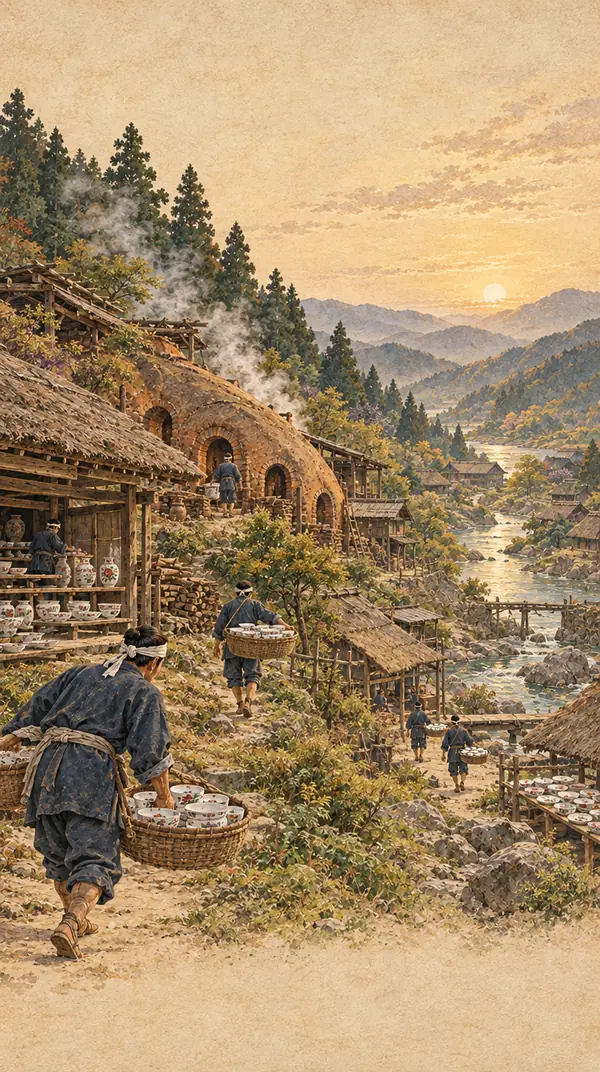
The first kiln was at the village of Kutani, in the Daishōji domain — a branch domain of the great Kaga domain.
Beginnings
Early Edo period
Painted porcelain was first made there in the early Edo period. How it was made is still debated.
A gap
About a century
The first kiln closed around the Genroku era (1688–1704). About a hundred years passed before a new kiln opened.
Revival
From 1807
A kiln opened in Kanazawa in 1807, and many more followed over the next sixty years, aiming to bring Ko-Kutani back.
01 · 古九谷
Ko-Kutani: a tradition, and a question
The early ware of Kutani is called Ko-Kutani 古九谷, “old Kutani”. It is counted with Kakiemon and Ninsei among the three sources of painted ceramics in Japan.
-
Early Edo period
A kiln at Kutani
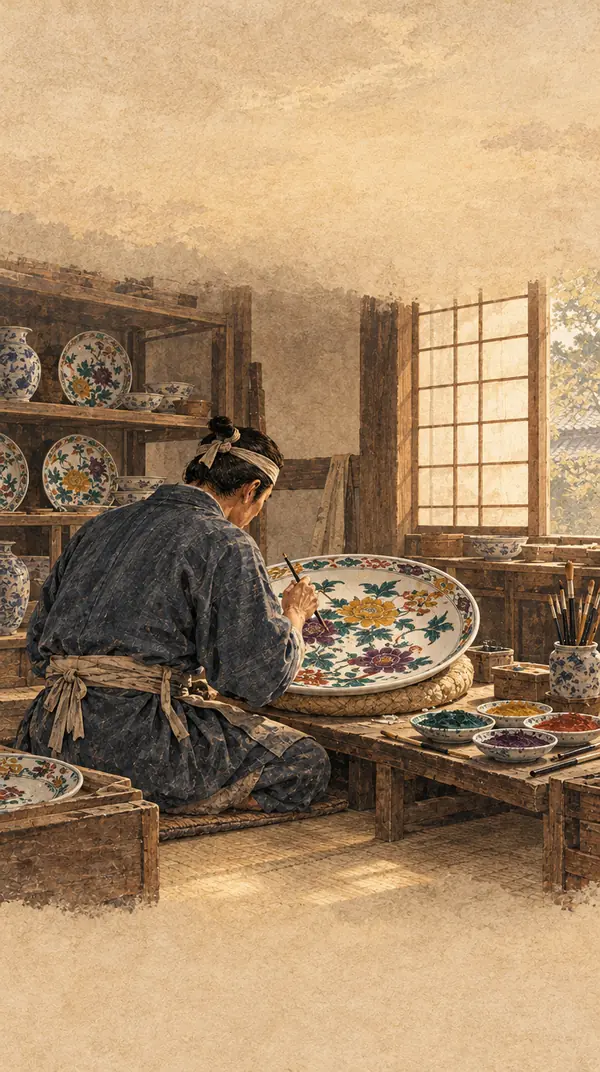
Making began at the village of Kutani, in the Daishōji domain, a branch of the Kaga domain.
-
As tradition has it
Porcelain methods from Hizen, painters invited
To bring in the porcelain-making methods of Hizen, several potters who had left Ming China are said to have been taken in, and painters invited — among them 久隅守景, of the school of 狩野探幽 — and so painted porcelain began.
-
About fifty years
The kiln closes
The Ko-Kutani kiln ran for about fifty years and closed around the Genroku era (1688–1704).
02 · 再興九谷
A century of silence, and the revival
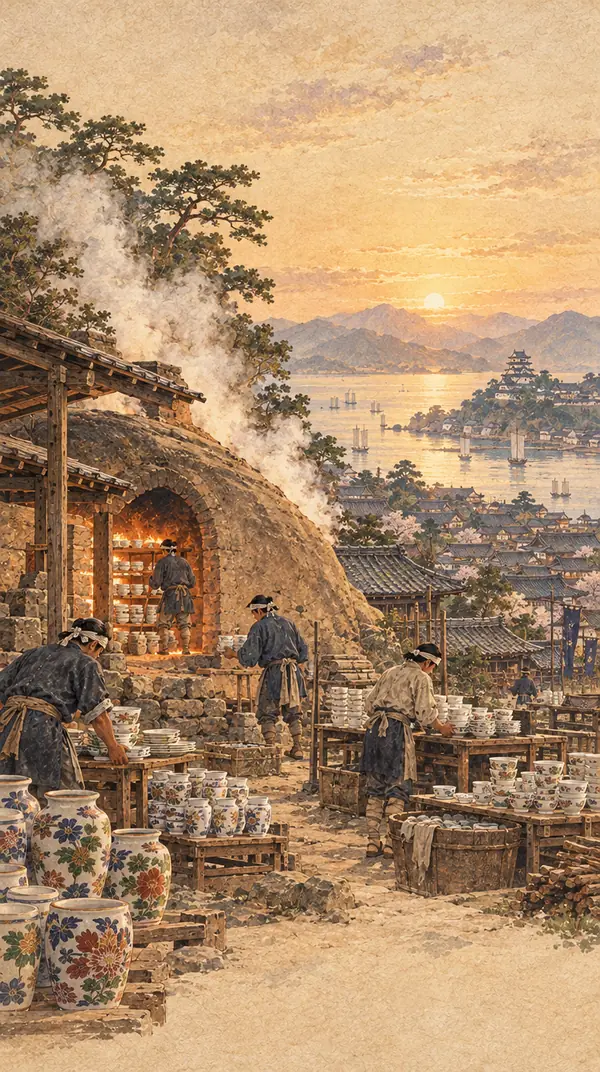
After the first kiln closed, no Kutani kiln worked for about a hundred years. Then the fires were lit again — this time in many places at once.

-
1807
Kasugayama kiln
A kiln opened at Kasugayama 春日山 in Kanazawa.
-
To the Meiji Restoration
“Revival Kutani”
Over about sixty years, the kilns of Saikō Kutani 再興九谷 opened one after another, aiming to revive Ko-Kutani. Noted potters were invited from other places to build up the craft, among them 青木木米 and 永楽和全.
-
1865
Gold brocade
At the Eiraku kiln in Yamashiro, 永楽和全 began the kinrande 金襴手 manner — gold laid over colour.
The Ko-Kutani manner and the Kyoto manner were both carried on in the revival kilns, and new ideas were added to them. The result is described as a range of styles with few parallels in other pottery districts. Many master craftsmen followed — above all 九谷庄三, Kutani Shōza — and laid the foundation of Kutani as it is today.
03 · 色絵・金襴手・焼成
Colour, gold and fire
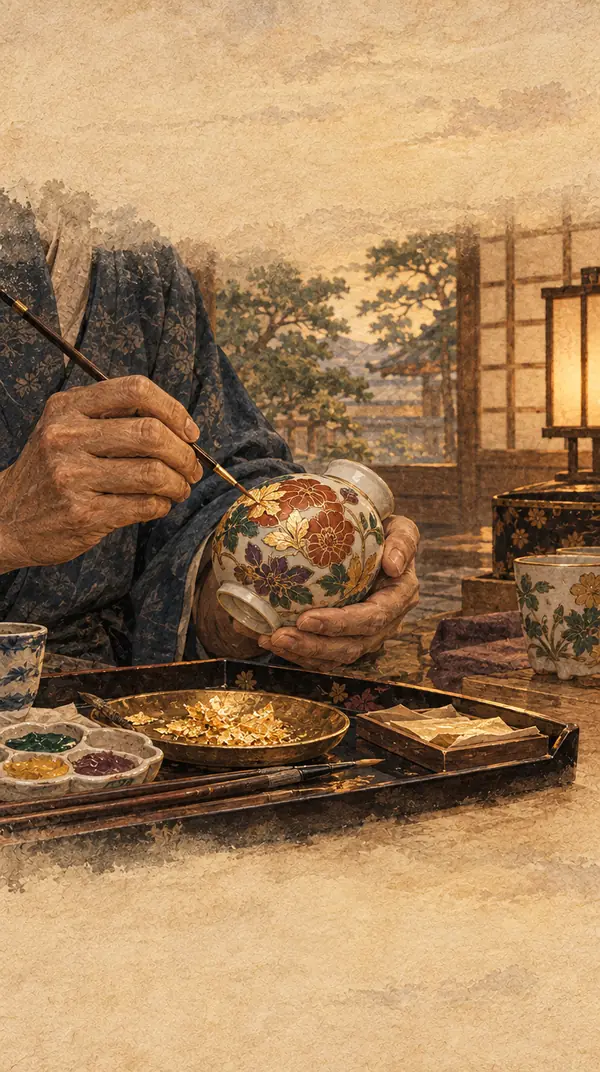
Kutani is known for decoration painted onto porcelain. The points below are drawn from documented pots and painters; they describe what has been recorded, not every Kutani piece.
Ko-Kutani manner
Deep colour
Ko-Kutani landscapes are described as painted in deep, dark enamels, with a strong, masculine force. Later pots copied that manner.
From 1865
Kinrande
Gold laid over coloured enamels — the kinrande manner — was begun in revival Kutani in 1865.
Around 1912
Aochibu
Aochibu 青粒: fine dots of blue packed closely over the ground. It arose in Kutani in the early Taishō years and spread among painters in Nomi and Kanazawa from about 1912. White and gold dots were used the same way.
Divided panels
Waritori
Shōza’s manner fills a large vessel with panels, each painted in many colours — flowers and birds, figures, landscapes, legends — in fine, realistic detail, with gold.
One painter’s method
Slip and glaze colours
粟生屋源右衛門 fired the body hard, covered it with white slip, drew the pattern in cobalt, then laid on glaze colours of blue, green, purple, yellow and brown before firing again.
Body and colour
Clay matters
The whiteness of the body changes how the enamels come out. One painter of small pots set out to work on the clay with his potter, aiming for the traditional red of Kutani.
04 · 文化と意匠
Motifs, forms and meanings
Kutani pots carry pictures, and the pictures carry meanings. A few recorded examples:
Three friends
Pine, bamboo and plum
One small pot on three feet is painted with the “three friends” — things that do a person good and keep them company, such as pine, bamboo and plum.
Good omens
Fuji and a hawk
Auspicious pictures such as Mount Fuji with a hawk appear on one gilded pot said to be Ko-Kutani.
Legend
Kinkō on his carp
Window panels may show figures from Chinese legend, such as the immortal 琴高 riding a carp, or peonies drawn from life.
Form
A crest-shaped pot
One lozenge-shaped pot follows matsukawa-bishi 松皮菱, a stepped lozenge known from family crests.
Kyoto elegance
A lighter hand
A pale, garlanded water tray is described as carrying the courtly elegance that 永楽和全 brought from Kyoto.
For export
“Dai Nippon”
A red-painted pot marked 大日本九谷盛楓堂製 is dated to the Meiji period from a mark meant for export. Who 盛楓堂 was is not known.
05 · 盆器
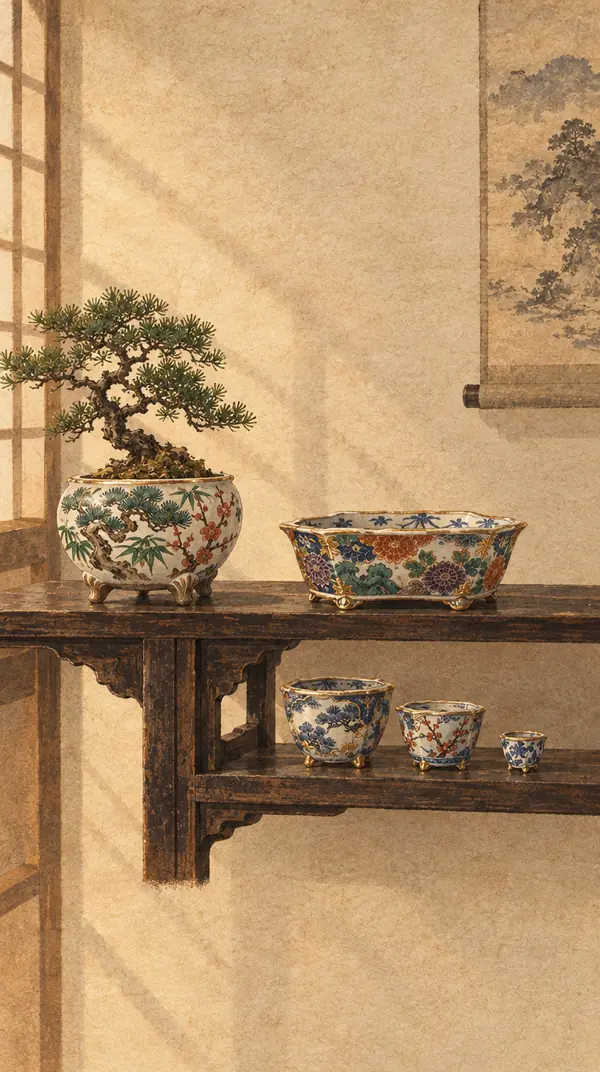
Kutani bonsai pots
The record does not say when Kutani began making bonsai pots. What it does show is a wide range: tiny pots, small round pots on feet, tall orchid pots, water trays, and pots for trees with fruit and flowers.
Very small
A set of three
A set of three blue-and-white pots with gold, the smallest only 1.6 cm long.
Tall
Orchid pots
Tall, richly painted orchid pots, one of them 33.5 cm high.
Trays
A water tray
A painted rectangular water tray 36 cm long, by 粟生屋源右衛門.
In use
Planted pots
Kutani pots appear in planting photographs: a blue-and-white hexagonal pot, and a round painted pot holding a fruiting akebia.
Gold, and the date it implies
Some gilded pots are said to be Ko-Kutani. Yet kinrande is recorded as beginning in revival Kutani in 1865. The record gives both, and so do we: a tradition about a pot and the date of a technique are two different kinds of evidence, and they do not always agree.
Painter and potter
A Kutani pot is often the work of two hands. One painter of small pots, 九谷錦生 (Kutani Kinsei), painted onto bodies made by 九谷勝山. A blue-dotted oval of his is described as rich but not loud — a pot that would add dignity to a tree.
06 · 絵師と窯
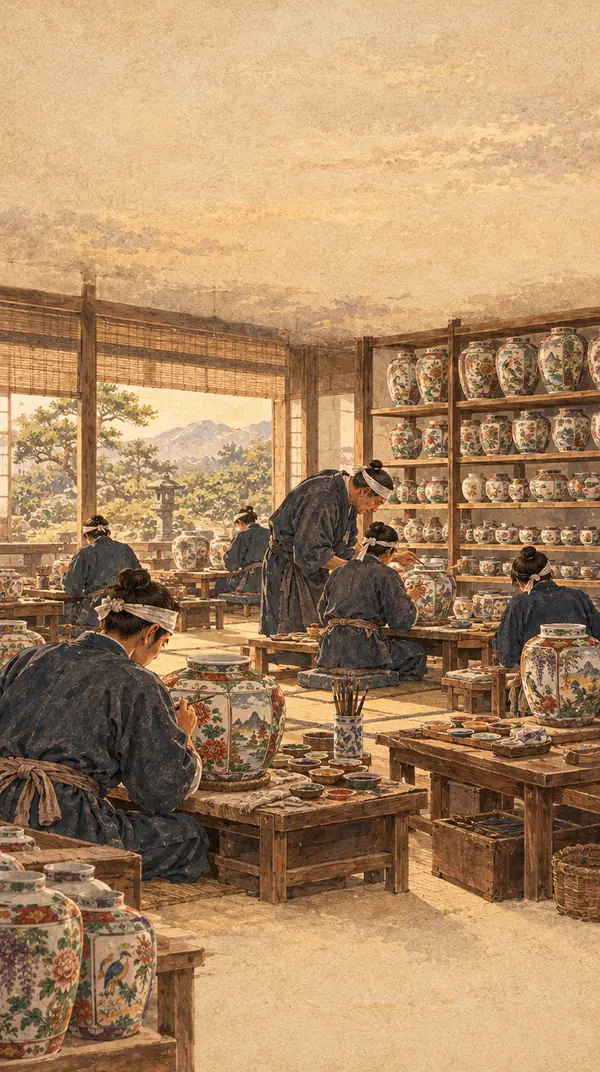
Painters, potters and kilns
Kutani has a great many kilns and workshops. The names below are those that recur in the record of Kutani bonsai pots. None of them has a page of their own on this site yet.
九谷庄三 — Kutani Shōza
1816–1883. A painter of porcelain who worked at the Wakasugi and Ono kilns, and finally in his home village of Terai. He searched the hills for cobalt and porcelain stone. His coloured, gold-rich manner is called Shōza style; around three hundred pupils are said to have trained in his workshop. One of his pots, signed 庄三, is singled out as one of the best-known Kutani bonsai pots.
粟生屋源右衛門 — Aoya Gen’emon
1789–1863. Chief potter at a run of kilns — Wakasugi, Yoshidaya, Matsuyama, Ono, Rendaiji — and the teacher of Shōza, among others. In his later years he built a kiln of his own and worked mainly in raku.
永楽和全
Invited from Kyoto during the revival. In 1865, at the Eiraku kiln in Yamashiro, he began the kinrande manner.
九谷錦生 — Kutani Kinsei
A painter of small bonsai pots, and a bonsai grower himself. He painted onto bodies made by 九谷勝山.
Kilns named in that record: Kasugayama in Kanazawa (1807); the Eiraku kiln in Yamashiro; and Wakasugi, Yoshidaya, Matsuyama, Ono and Rendaiji, where Aoya worked.
07 · 落款と見方
Reading a Kutani mark
Kutani has so many kilns, and so many ways of marking a pot, that no single mark stands for it. Read a mark for what it can settle, and no more.
Kaku-fuku
Not proof either way
The character 福 in a double square — kaku-fuku 角福 — was first an Imari mark. It is said that Kutani painters copied it along with everything else when they made copies of old Imari, and it stuck. It does not make a pot Kutani, and it does not make it Imari.
Two hands
Painter or potter
Kutani work is divided between painter and body-maker. A pot may carry both their marks, or only the painter’s, or only the potter’s. A mark is not simply “the maker”.
Dating clues
Technique, not tradition
Kinrande gold points to 1865 or later; aochibu dots to the early Taishō years or later. A box or a tradition that says “Ko-Kutani” has to be weighed against that.
Export marks
“Dai Nippon”
A mark beginning “Dai Nippon” was used with export in mind; one such pot is dated to the Meiji period from it.
These are documented forms, not a complete list, and a mark is evidence to weigh, not proof. The marks index sets out the marks recorded so far on this site. If a mark puzzles you, send us a clear photograph and we will tell you what it says — we do not issue authentications.
08 · YAKUMO の九谷鉢
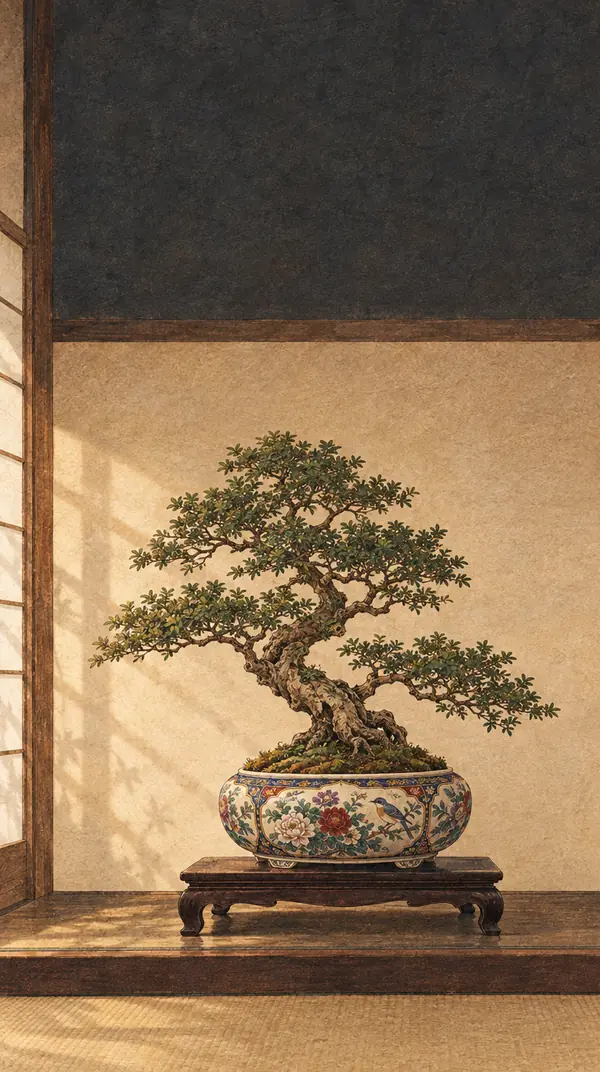
Kutani pots at YAKUMO JAPAN
Our Kutani selection changes as pots come and go. The link below opens the live Kutani section of our eBay store, so it always shows what is available now. The pictures on this page are illustrations, not pots for sale.
Browse Kutani bonsai pots on eBay →
Listings ship from Tokyo; destination availability and terms are shown on eBay.
09 · Continue
Keep reading
The marks, glazes and forms on this page each have more to say on their own pages.