Places · 京焼
Kyoto
Colour, blue and the capital’s kilns, from Ninsei to the bonsai pot
Kyoto ware divides broadly into Awata ware, mostly pottery, and Kiyomizu ware, mostly porcelain. It is known above all for overglaze enamels and underglaze blue.
Kyoto ware, Kyō-yaki, is not one kiln but the name for the pottery and porcelain of Kyoto, known above all for rich enamel colours and underglaze blue. This page follows it from the potter called its founder, through the masters who came after him, to the orchid pots, export pieces and tiny painted pots recorded among bonsai pots — and to why so few of them can be tied to a named maker.
00 · At a glance

Kyoto ware, in four points
A collective name
Pottery and porcelain
Kyoto ware is the general name for the ceramics produced in Kyoto — not a single clay, glaze or kiln. It includes both pottery and porcelain.
Known for
Enamel and blue
It is known above all for rich overglaze enamels, 色絵, and underglaze blue, 染付.
Two lines
Awata and Kiyomizu
It divides broadly into Awata ware, mostly pottery, and Kiyomizu ware, mostly porcelain.
Bonsai pots
Few named makers
For Kyoto ware, a pot with a mark is rare. Many of the recorded pots are attributed to Kyoto without a known maker or workshop.
01 · 仁清と京焼のはじまり
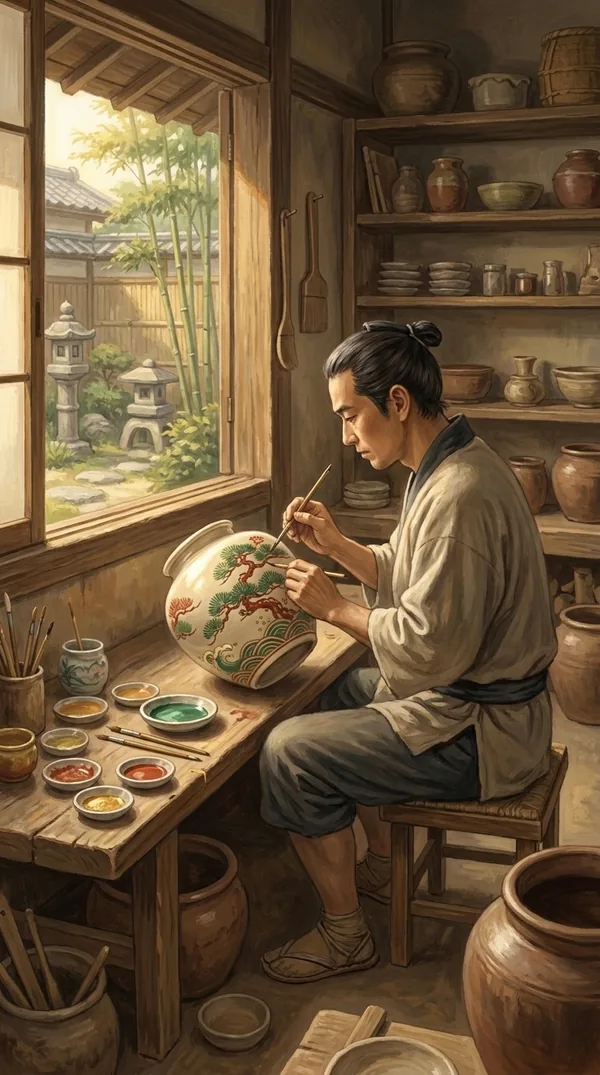
Ninsei, and enamelled pottery
Pots had been made in Kyoto, the old capital, for a very long time. What changed in the early Edo period was the arrival of one potter, Ninsei 野々村仁清, who is called the founder of Kyoto ware. With him, graceful and richly coloured enamelled pottery was brought to completion for the first time.
-
Long before
An old capital
Ceramics are made in Kyoto from early times.
-
By about 1649
Ninsei is known
In the Keian era, Ninsei is already well known. His dates of birth and death are not known.
-
By 1695
Ninsei has retired
By the eighth year of Genroku, he has retired.
What is known of Ninsei comes in dates like these — when he was already famous, and when he had stopped — rather than in a full life story.
02 · 名工と粟田・清水
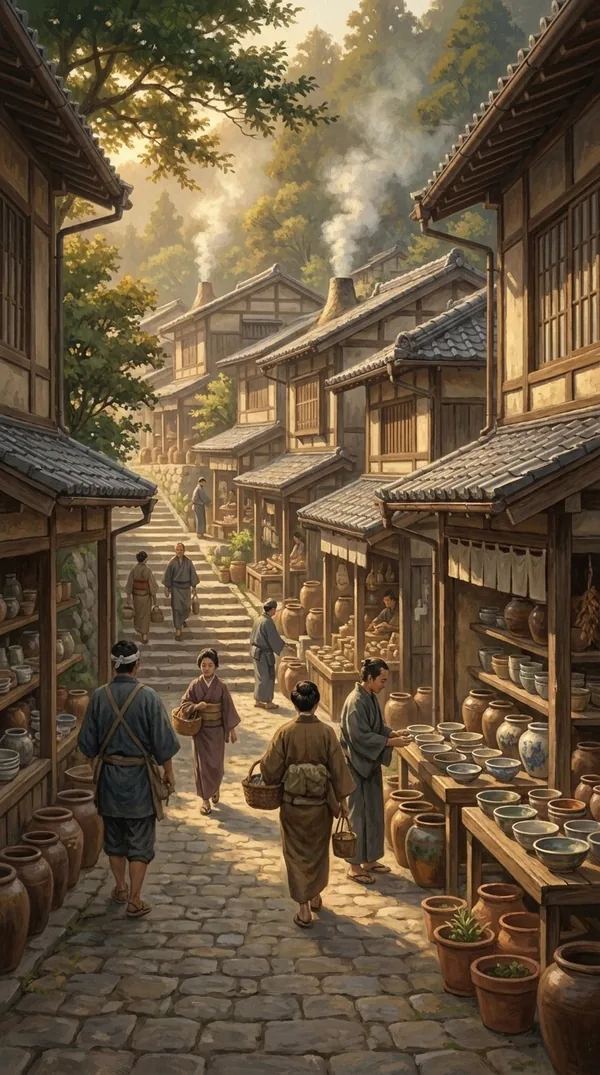
The masters who followed
After Ninsei, Kyoto produced one celebrated potter after another, and became the centre of the potter’s craft, in name and in fact. The names usually given include:
Ogata Kenzan 尾形乾山
Eisen 奥田頴川
青木木米
Takahashi Dōhachi 高橋道八
Eiraku Zengorō 永楽善五郎
尾形周平
和気亀亭
Kiyomizu Rokubei 清水六兵衛
Seifū Yohei 清風与平
Some names are given here in Japanese only, where we have not confirmed how they are read.
Awata and Kiyomizu
Kyoto ware divides broadly into two lines: Awata ware 粟田焼, mostly pottery, and Kiyomizu ware 清水焼, mostly porcelain. Between them they cover everything from subdued Raku ware to the Ninsei manner, so Kyoto ware is hard to sum up in a word — and tea, tableware, decorative arts and export markets all shaped what was made.
What can be said is this: Kyoto potters kept their traditions while always wanting new designs, and kept improving their techniques — and that is what kept the industry alive and growing.
Still changing
The habit of change carried into modern times. Movements to renew ceramics as an art — among them Sekido-sha 赤土社 and 日本陶彫協会, a ceramic-sculpture association — began among young Kyoto potters.
03 · 陶器と磁器・色と青
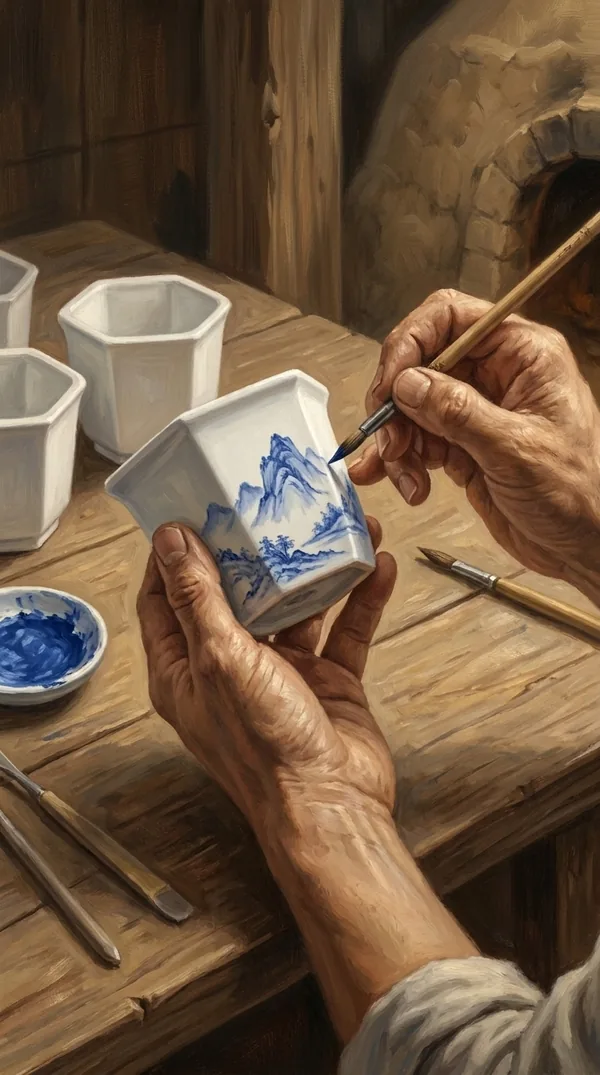
Pottery and porcelain, colour and blue
The bonsai pots recorded from Kyoto show the same range as Kyoto ware itself. The points below are drawn from those pots and what is written about them; they are not a rule for every Kyoto pot.
Enamel
Red and colours
Pots painted in overglaze enamels, 色絵, and in red, 赤絵 — among them a red-painted hexagonal pot with landscapes and figures.
Blue
Underglaze blue
Small porcelain pots painted in underglaze blue, 染付, such as a hexagonal pot with a landscape.
After Kōchi
Three colours and deep blue
Pots made in the manner of Kōchi ware 交趾, in three-colour glazes and in a deep lapis-blue glaze, 瑠璃釉.
Gold
Gold on blue
A translucent deep lapis-blue pot with auspicious motifs and a phoenix in gold, and a thick tea-green glaze laid on in the Kōchi manner.
Gold, held back
Of that blue-and-gold pot, the record says the design is skilfully restrained — it uses gold without tipping into show — and that it reaches a high level both as a bonsai pot and as a work of ceramic art.
04 · 仁清写と蘭鉢
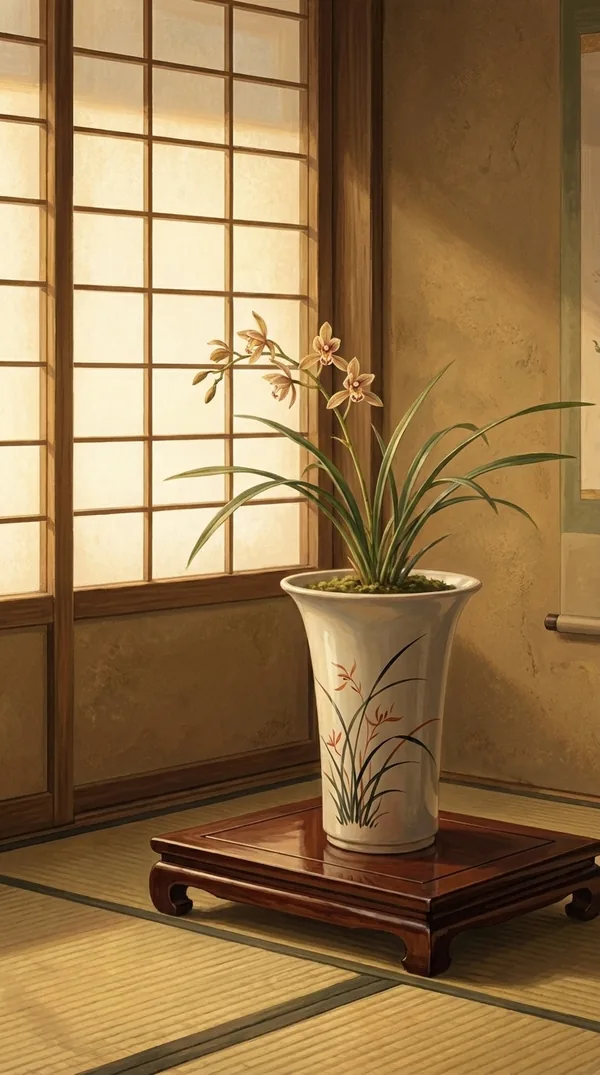
Orchid pots in the Ninsei manner
No bonsai pot made by Ninsei himself has come down in the bonsai world. But there is a pot made later, it seems, in his memory, and it is treasured under the name Ninsei-utsushi: an orchid pot in the Ninsei manner, painted with heavenly horses.
Who made it
Not Ninsei
It is thought to be Kyoto ware, but its place and maker are both unknown. It is not Ninsei’s own work.
The painting
Black and red
Heavenly horses are painted on the front and the back, one in black, one in red — in the glazes known as Ninsei black and Ninsei red.
As an orchid pot
A fine one
It carries the elegant Ninsei style and is counted a fine orchid pot. It is said to be the only one of its kind in the bonsai world.
How it was found
Soon after the war
A collector of pots saw it at a second hall of the Kokufū bonsai exhibition soon after the war, and bought it for its graceful shape and the wide space left around its painting.
Orchids, peonies and sweet flag
Other Kyoto pots point the same way. A long blue-and-gold oval is thought perhaps to have been made for flowering plants — orchids, peonies or sweet flag — and, either way, quite possibly made to order for a daimyo or someone of that standing in the Edo period. Its maker is unknown; it is thought to come from a kiln with the Kyoto tradition. Its base is decorated with scrolling foliage, and its side with a paulownia motif.
05 · 盆器
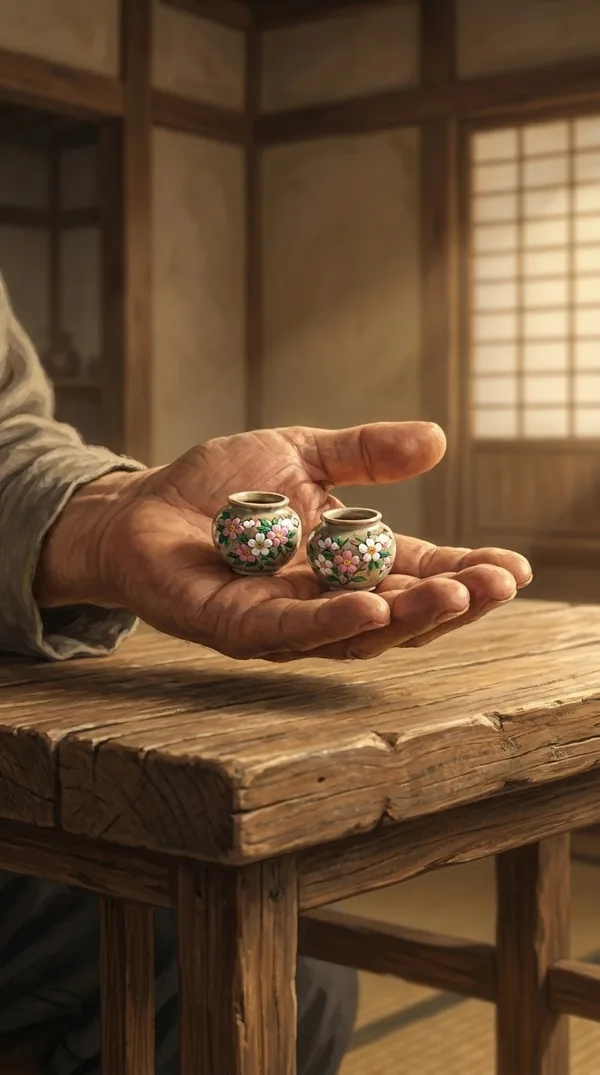
Kyoto bonsai pots
The Kyoto pots recorded among bonsai pots are varied, and most have no known maker. A few groups stand out:
Made for export
Kyō-Satsuma
Pots called 京薩摩, painted in enamels, some in the gold-rich 金襴手 manner. One deep round pot, 18.3 cm, painted with a figure in a long-sleeved kimono carrying sea water, is described as made for export; the subject is called a rare one. These were made in Kyoto; they are not Satsuma ware from Kagoshima.
In the Kōchi manner
A pair of tortoiseshell shapes
Two tortoiseshell-shaped pots of nearly the same size, 13.7 and 14 cm, one in three colours and one in deep blue. The three-colour pot had at times been called Canton three-colour ware or Kotō ware.
Tiny pots
Thumb-sized
Painted flowered pots of about 3.4 cm, in a pair and in a set of two. The painting on one is cherry; its owner reads the other as camellia.
Small pots
Blue and white, blue and red
Small pots of about 8 cm: a hexagon painted in underglaze blue, and a blue-glazed rectangle with a landscape painted in red over white slip on its panel.
Where a pot came from
The pair in the Kōchi manner shows how hard placing an unmarked pot can be: the three-colour one had at times been called Canton three-colour ware or Kotō ware, and is now thought to be Kyoto ware — supported by its blue twin, which carries a mark.
06 · 落款と見方
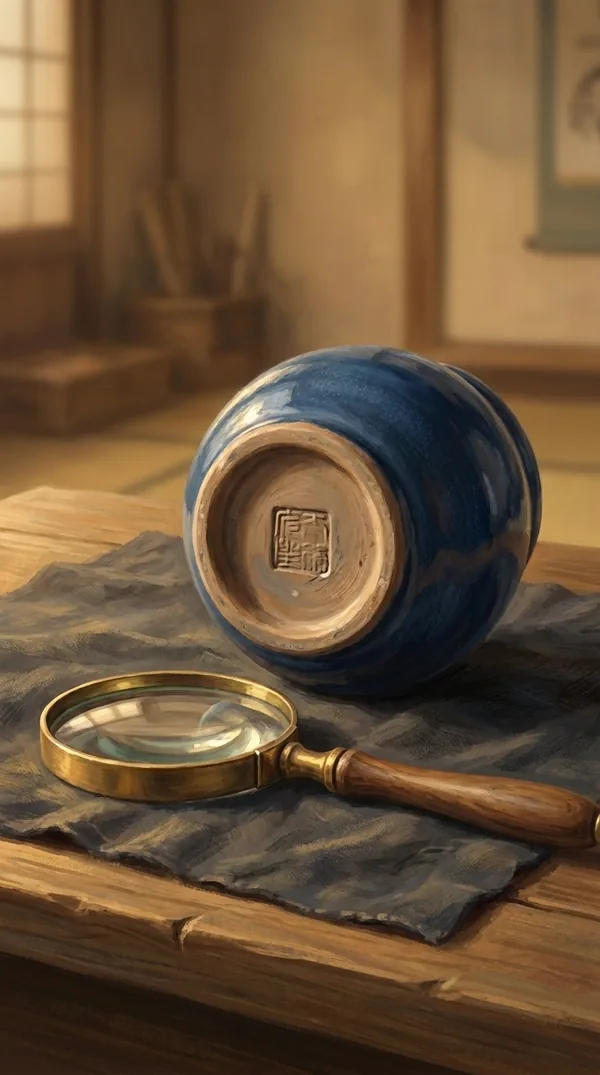
Reading a Kyoto mark
Kyoto ware is a collective name. On its own, “Kyoto” names a place and a tradition; it does not name a maker. And for Kyoto bonsai pots, a mark of any kind is rare.
A rare mark
雨遊芳造
The deep-blue tortoiseshell pot carries a seal that is hard to read, but can be read as 雨遊芳造. A link has been suggested with Amenomori Hōshū 雨森芳洲 (1668–1755), a Confucian scholar of the mid-Edo period who served as interpreter for the Korean embassies to Japan. It is a suggestion, not a finding.
Why it matters
One pot places another
That mark is one reason its three-colour twin is thought to be Kyoto ware.
A name on a small pot
濤山
A small blue-and-white hexagonal pot is marked 濤山; who that is is not known. A link with a Kyoto potter of the Meiji era has been suggested, and a small blue-and-red rectangle of unknown maker has been linked to the same name — but neither is settled.
Without a mark
Placed by comparison
Because a mark is rare, an unmarked Kyoto pot can sometimes be placed only by comparison with a marked piece of the same kind — as with the pair above — and sometimes not at all.
These are documented forms, not a complete list, and a mark is evidence to weigh, not proof. The marks index sets out the marks recorded so far on this site. If a mark puzzles you, send us a clear photograph and we will tell you what it says — we do not issue authentications.
07 · 京都の作家
Kyoto makers on this site
Several makers already on this site worked in Kyoto. Their own pages tell their stories in full:
Heian Tofukuji 平安東福寺
A Kyoto maker who fired in shared kilns — see also Kilns & places.
Tofukuji II 二代 平安東福寺
The second generation, and how to tell the two apart.
Tsukinowa Yūsen 月之輪涌泉
A painter of Kyoto porcelain who turned to small painted pots.
Kyoto also reached other kilns. The Kutani page tells how a Kyoto potter was invited to Kutani during its revival.
08 · YAKUMO と京焼
Kyoto at YAKUMO JAPAN
Our eBay store has a Kyoto Kiyomizu section. The link below opens it, so it always shows what is available now. The pictures on this page are illustrations, not pots for sale.
Browse Kyoto Kiyomizu pots on eBay →
Listings ship from Tokyo; destination availability and terms are shown on eBay.
09 · Continue
Keep reading
The marks, glazes and forms on this page each have more to say on their own pages.