Places · 鍋島焼
Nabeshima
A domain’s own porcelain, and its rare recorded bonsai pots
Nabeshima ware is the Saga domain’s own porcelain, within the Imari tradition. Its recorded bonsai pots are rare.
Nabeshima ware is part of the Imari porcelain tradition: exceptionally high-grade porcelain made at a kiln run directly by the Saga domain, for giving rather than for sale. It was made with a strict division of labour and strict inspection, and almost all of it was tableware. This page follows that history to the very few bonsai pots recorded from Nabeshima — and to why they are so few.
00 · At a glance

Nabeshima, in four points
Part of Imari
A domain’s porcelain
Within Imari ware, Nabeshima was exceptionally high-grade porcelain made at a kiln run directly by the Saga domain.
Purpose
For giving
Its wares went as gifts to court nobles, daimyo and others. In principle they were not sold on the open market until the Meiji Restoration.
Making
Strictly checked
Work was divided among specialists, and finished pieces were inspected twice; those below the standard were destroyed.
Bonsai pots
Very few
About nine tenths of Nabeshima was tableware. Bonsai pots are very few, and coloured ones rarer still.
01 · 藩窯のはじまり
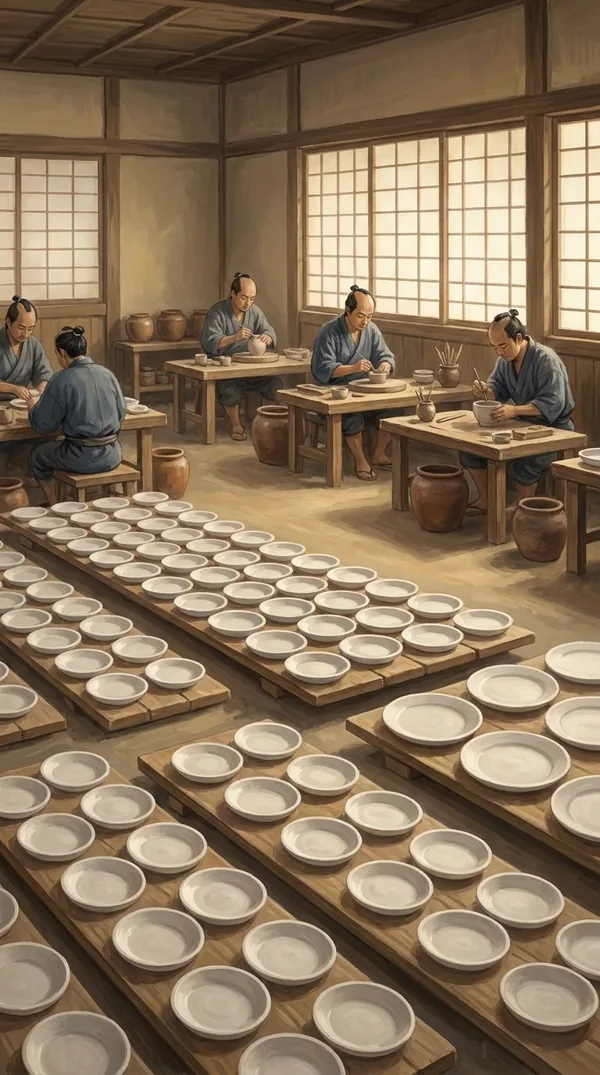
A domain’s own kiln
Within Imari ware, Nabeshima was exceptionally high-grade porcelain made at a kiln run directly by the Saga domain, its official kiln 御用窯.
-
First
Near Arita
The kiln first stands in the Arita area.
-
Later
Okawachiyama
It moves to Okawachiyama 大川内山, roughly halfway between Arita and Imari.
-
Throughout
Gifts
Its products are set aside as gifts for court nobles, daimyo and others.
-
After the Restoration
A private company
With the Meiji Restoration the kiln becomes a private company. Until then its wares are, in principle, not on general sale.
02 · 分業と検品
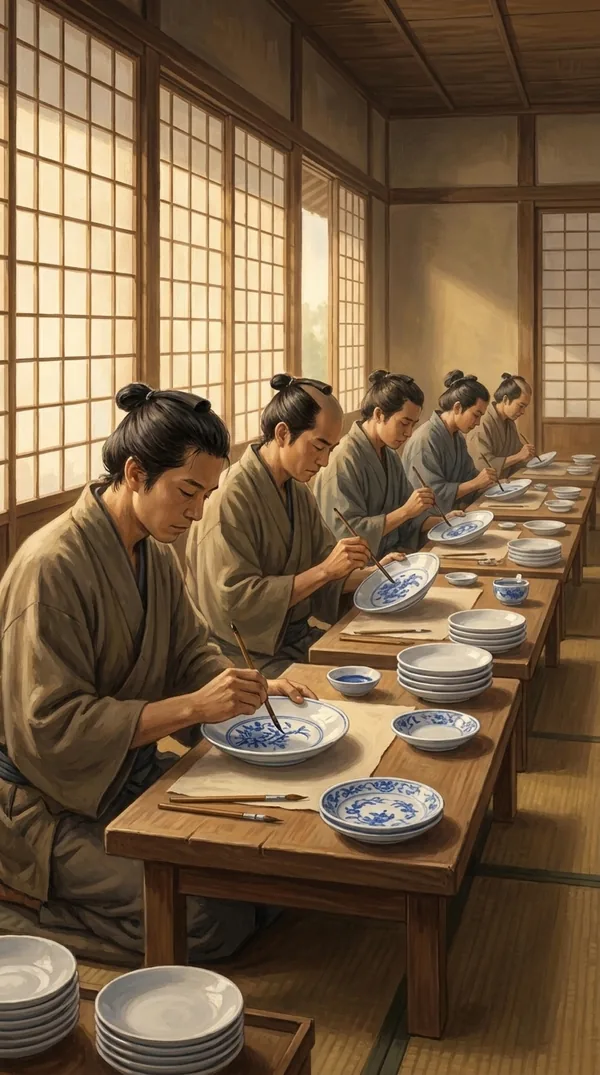
Division of labour, and inspection
Porcelain at the Okawachiyama kiln was made under a complete division of labour, likened to that of Jingdezhen in China, and the inspection was very strict.
Twice checked
Before and after firing
Pieces were inspected twice — when the underglaze blue was finished, and again after firing.
Below standard
Destroyed
Anything that fell short of the standard was destroyed. This is why Nabeshima has a reputation for being flawless — a reputation, not a guarantee for every piece.
Strict control is part of the Nabeshima story. It is not a promise that any particular object, then or now, is without fault.
03 · 染付・青磁・色絵
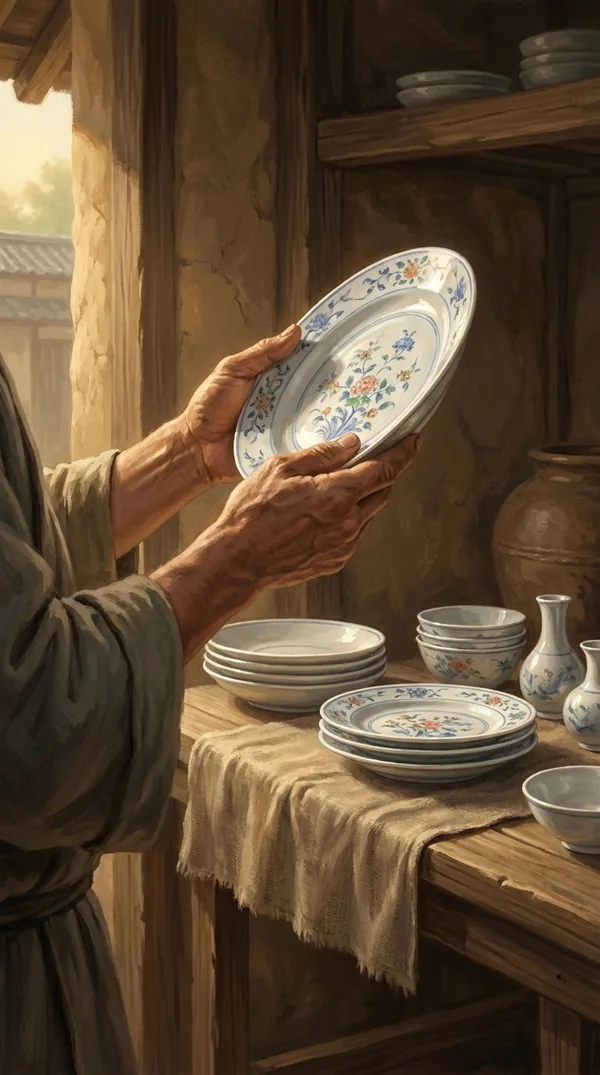
Blue, celadon and colour
Nabeshima includes underglaze blue, 染付, and celadon, 青磁. But its best-known work is in overglaze colour — the so-called Iro-Nabeshima 色鍋島, “coloured Nabeshima”.
Form
Exact
The forms are described as precisely made.
Painting
Fine
The drawing is described as delicate and exact.
Design
Bold
The designs are described as bold.
Colour
Rich
The colouring is described as rich and splendid.
Iro-Nabeshima is only one part of Nabeshima. Among bonsai pots, as the next chapters show, blue and lapis-blue glazes are far more common than colour.
04 · 贈答と器
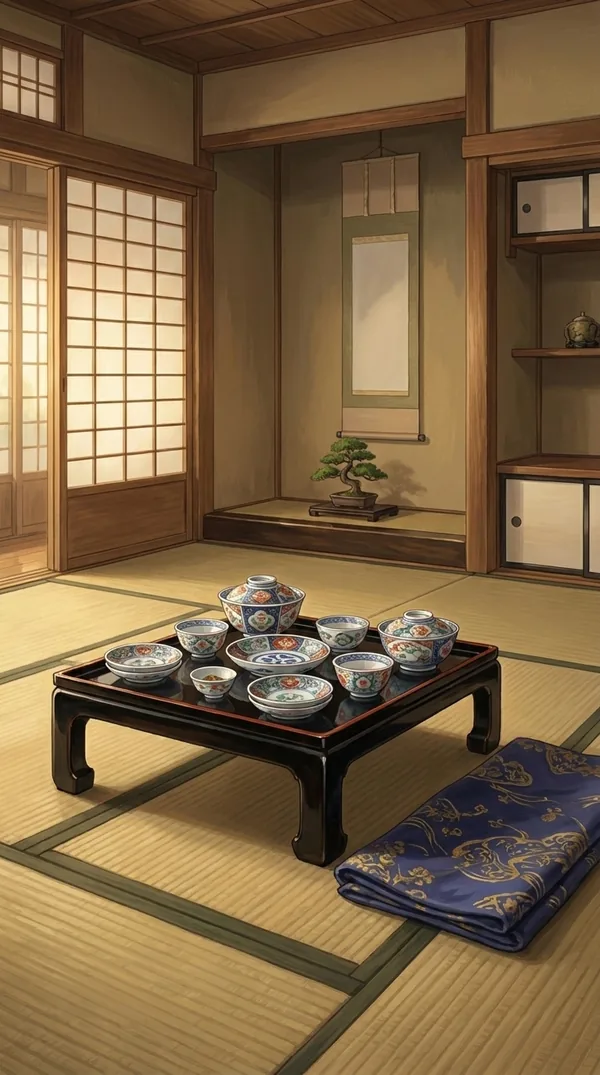
Made for giving
The best-known Nabeshima pieces are dishes, bowls and small serving dishes for the kaiseki meal. They are said to make up about nine tenths of the whole.
The rest
About one tenth
Sake bottles, incense burners, jars, kettles, inkstone screens 硯屏, paperweights and the like.
Even the small
Finished craft
The record treats even the smallest of these as finished works of craft.
Made for official gifts, and in principle not on general sale until the Meiji Restoration, Nabeshima was porcelain for a small circle.
05 · 盆器
Nabeshima bonsai pots
Bonsai pots are almost absent from Nabeshima. The few recorded are mainly in underglaze blue or lapis-blue glaze, 瑠璃釉; coloured ones are so rare as to be almost unknown — almost, not entirely. The group recorded is small:
Lapis blue
A banded round pot
A deep, clear lapis-blue round pot, 12.2 cm, long known as a fine Nabeshima bonsai pot. A raised band on its body is painted with three lines in white and iron glaze — detail the record describes as typical of Nabeshima care.
Tiny pair
Bamboo nodes
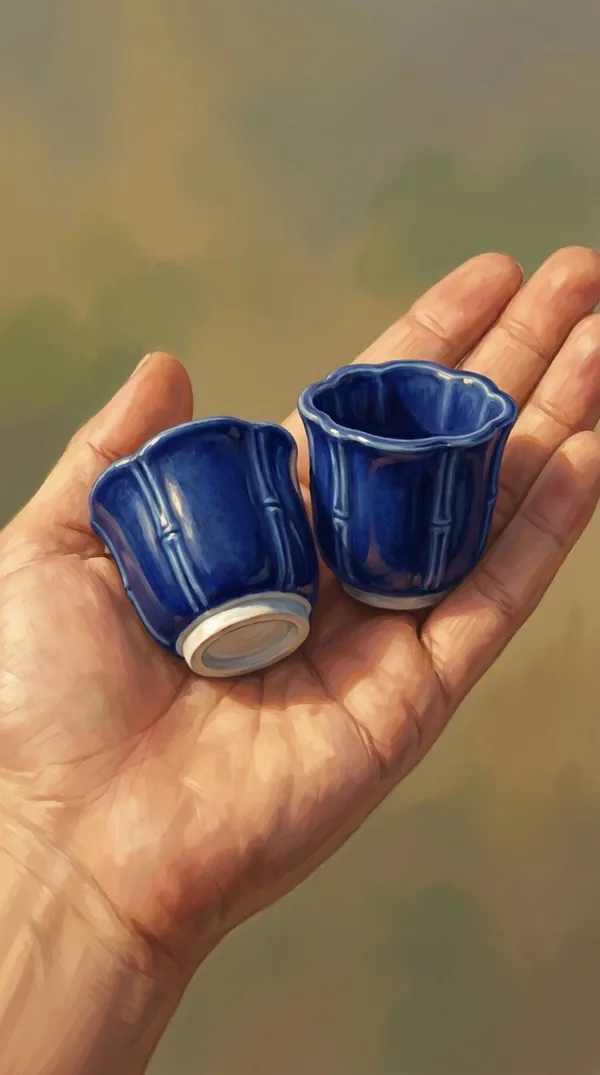
Two tiny lobed pots, 4.6 cm, small enough to sit in a palm: one glazed right down to the foot, the other leaving white porcelain bare. Bamboo nodes carved into the body show through as the glaze thickens and thins. Perhaps made to order for a lover of tiny bonsai.
A set of three
Crabs and a creel
Three orchid pots of the same design in three sizes, 26.5, 19.7 and 16.3 cm. Glossy lapis-blue made with fine underglaze-blue pigment sets off an applied fish creel in soft red and tea-green, with a crab or two escaping it. Parts have been mended with gold.
Colour, and openwork
The rarest
Two coloured Iro-Nabeshima round pots, 9 and 28 cm, and a pair of blue-and-white pots with openwork, 21.5 and 18.5 cm.
The record does not give when, or in which workshop, each was made. They are recorded as Nabeshima; none of them dates or describes Nabeshima as a whole.
06 · 落款と継承

Marks, and what came after
Nabeshima was a domain kiln, not a single potter’s workshop, so it is treated here as a category rather than as a maker.
Marks
None recorded here
The YAKUMO marks index currently records no individual maker’s mark for Nabeshima. That describes our index and sources; it is not a rule that every Nabeshima piece is unmarked.
After the Restoration
A private company
The domain kiln became a private company with the Meiji Restoration.
Colour, handed on
今泉今右衛門
The techniques of Iro-Nabeshima were handed on to the 今泉今右衛門 kiln.
Neighbours
Imari
Nabeshima belongs to the wider Imari porcelain tradition.
A mark is evidence to weigh, not proof. The marks index sets out the marks recorded so far on this site. If a mark puzzles you, send us a clear photograph and we will tell you what it says — we do not issue authentications.
07 · YAKUMO と鍋島

Nabeshima at YAKUMO JAPAN
We do not have Nabeshima pots listed at the moment, and our eBay store has no Nabeshima section. Our pots are grouped there by kiln and origin; the link below opens that section, so it always shows what is available now. The pictures on this page are illustrations, not pots for sale.
Browse bonsai pots by kiln and origin on eBay →
Listings ship from Tokyo; destination availability and terms are shown on eBay.
08 · Continue
Keep reading
The marks, glazes and forms on this page each have more to say on their own pages.